Oven to Air Fryer Conversion Calculator
Oven to air fryer conversion calculator
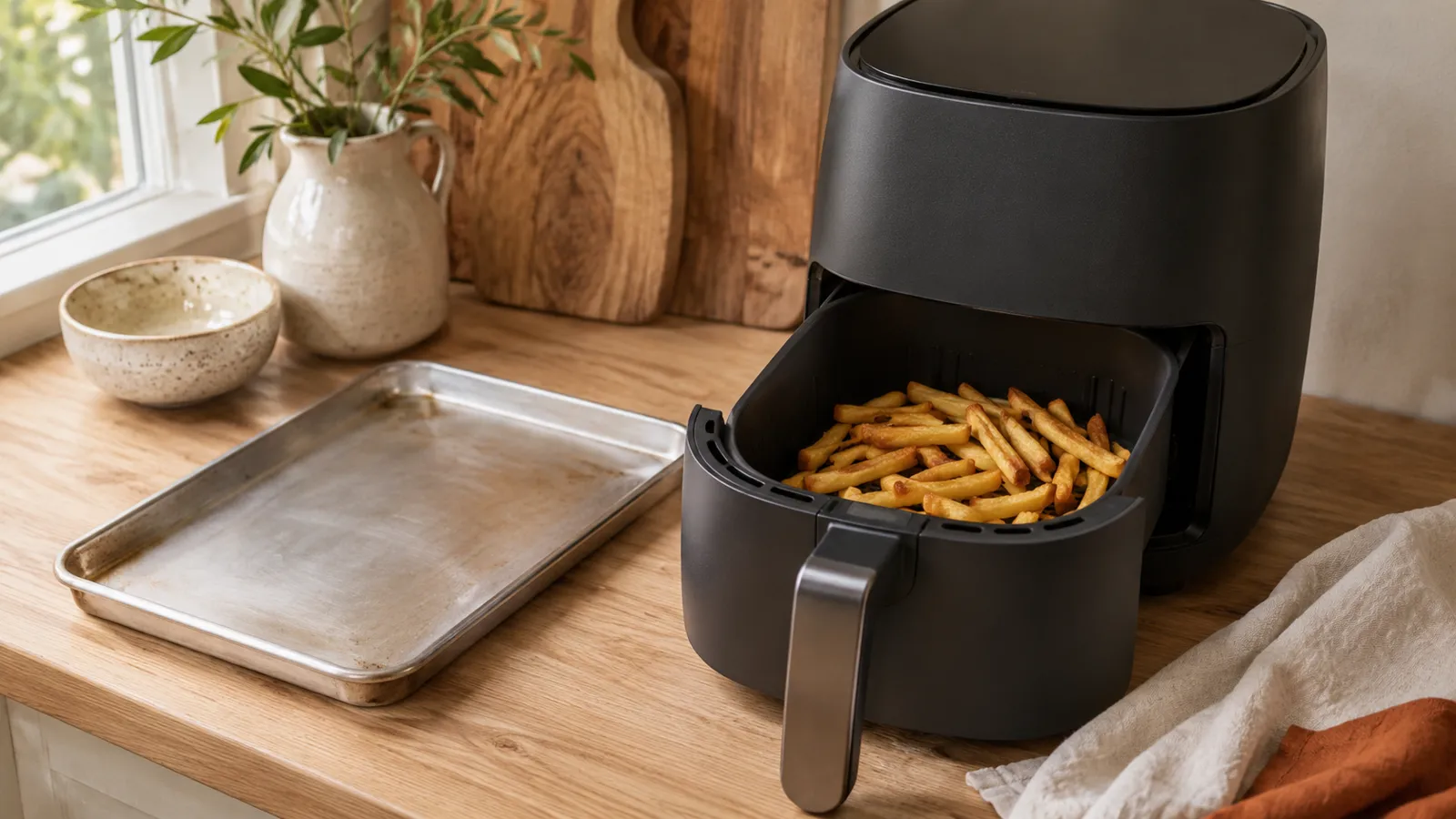
To convert a conventional oven recipe, set the air fryer 25°F (about 14°C) lower and cook for 20% less time. So 400°F for 20 minutes becomes 375°F for 16. Check early and use a thermometer for meat.
| Oven | Air fryer | Oven time | Air fryer time |
|---|---|---|---|
| 300°F (150°C) | 275°F (135°C) | 10 min | 8 min |
| 325°F (165°C) | 300°F (150°C) | 15 min | 12 min |
| 350°F (175°C) | 325°F (165°C) | 20 min | 16 min |
| 375°F (190°C) | 350°F (175°C) | 30 min | 24 min |
| 400°F (205°C) | 375°F (190°C) | 45 min | 36 min |
| 425°F (220°C) | 400°F (200°C) | 60 min | 48 min |
Oven to air fryer conversion: the rule
From a conventional oven recipe, set the air fryer 25°F lower and cook for 20% less time. That is KitchenAid's published rule, and most calculators use it. I think it's the right place to start, because it's simple enough to remember at the stove and it comes with a manufacturer's name behind it. It's still a rule of thumb. Ninja's AF160 manual, sold in Europe, tells owners to reduce by 10°C, which is smaller, so an air fryer's own booklet outranks any general rule, this one included.
In Celsius, the reduction is about 14°C, not 25°C: the calculator converts properly and rounds to the nearest 5, since nobody's dial can set 186.1°C. At a 400°F limit it rounds down to 200°C, as in the chart, to stay under 204°C.
What does 350°F, 375°F or 400°F equal in an air fryer?
- 350°F oven: 325°F in the air fryer, for 20% less time.
- 375°F oven: 350°F.
- 400°F oven: 375°F. Twenty minutes in the oven becomes 16.
- 425°F oven: 400°F, which is the ceiling of many air fryers.
- 450°F oven: 425°F, which many machines can't reach. See below.
Does an air fryer cook faster than an oven?
Generally yes, which is why the rule cuts both temperature and time. KitchenAid describes air fryers as working much like convection ovens, with a heating element and a fan moving hot air around a small space. The calculator's first-check time, halfway through the converted time before any added cap time, is my own reminder, not a manufacturer's figure. I'd keep it. Opening the basket costs you very little, and it's the moment most air fryer instructions want you to shake or flip anyway. KitchenAid notes most air fryers need at least one shake.
What if the recipe needs more heat than your air fryer can give?
Many calculators happily tell you to set 475°F, which few air fryers can reach. This one caps the result at your machine's maximum. Maximums really do vary: Ninja's European AF160 manual gives 200°C for Air Fry and 240°C only for Max Crisp, so check yours. When the conversion hits the cap, the tool holds the temperature at your maximum and lengthens the time in proportion to the shortfall. A 500°F, 90-minute oven recipe becomes 400°F for 86 minutes instead of 72.
That extra time is this site's estimate, because I found no manufacturer figure for it. I chose proportional stretching because it's simple and it errs toward cooking longer. For a recipe that really needs that much heat, I'd ask whether the air fryer is the right appliance at all.
Do I convert a convection oven recipe?
I wouldn't. A convection oven already moves hot air, and some ranges compensate for it: LG's, for one, automatically reduce the set temperature by 25°F in convection modes. My reasoning, not a published rule, is that a recipe written for a fan oven has already allowed for that moving air, so taking another 25°F off risks cutting twice. For a fan-oven recipe, the tool keeps the temperature and takes 20% off the time. I found no manufacturer figure for that exact case, so it's my estimate, and I'd check early. When in doubt about which oven a recipe assumed, treat it as conventional, since that's what most recipe writers mean by default.
Frozen food in the air fryer
I found no authority for a frozen-food conversion, and the calculators that imply one disagree with each other by a wide margin. Follow the air fryer directions on the package when there are some. Without them, the general conversion is a starting point only, and I'd check early and go by what you see. The food picker doesn't change the numbers for frozen food; it only tells you this.
Can you bake in an air fryer?
You can, but I wouldn't start with anything delicate. KitchenAid says the heat intensity of air fryers isn't ideal for moist or delicate bakes such as cakes or soufflés, and that countertop ovens with an air fry setting are better suited. If a cake recipe was written for an oven and you have one, I'd use the oven. For cookies or quick breads, look for a recipe written for your appliance and pan.
Basket, oven-style or dual-zone air fryer?
I couldn't find a manufacturer rule that separates these for conversion, so the calculator treats them alike rather than inventing a difference. The practical differences are about airflow: don't overcrowd, as KitchenAid says, because the circulating air should reach as much of the food as possible. Spread food out and work in batches. A full basket will need longer than the calculator says, and I'd take batches over one crowded load every time.
Use a thermometer for meat and fish
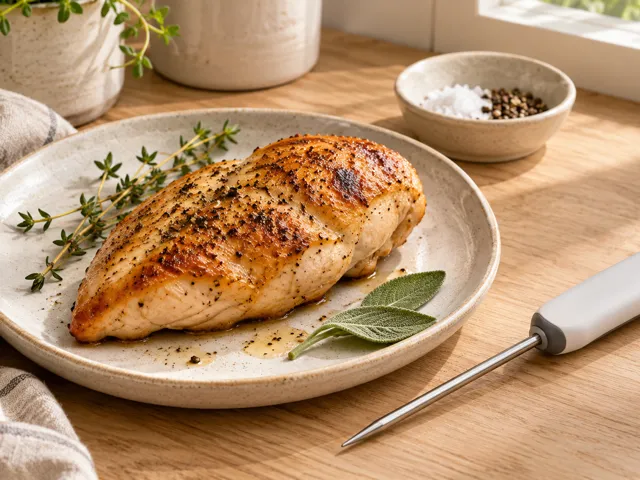
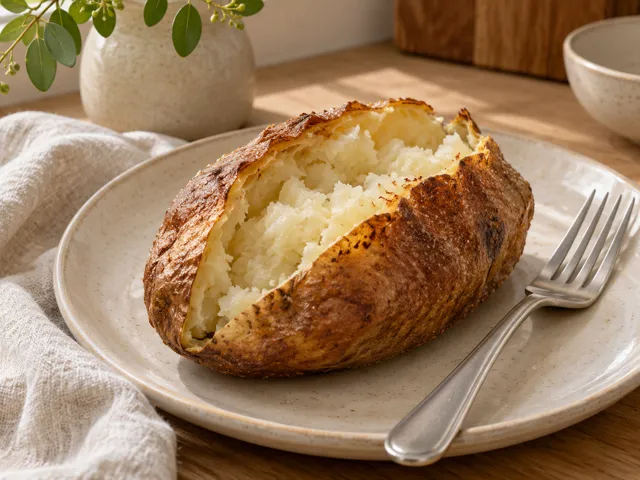
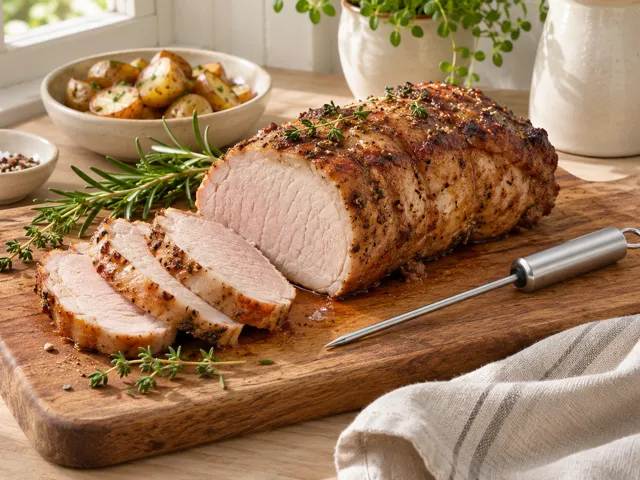
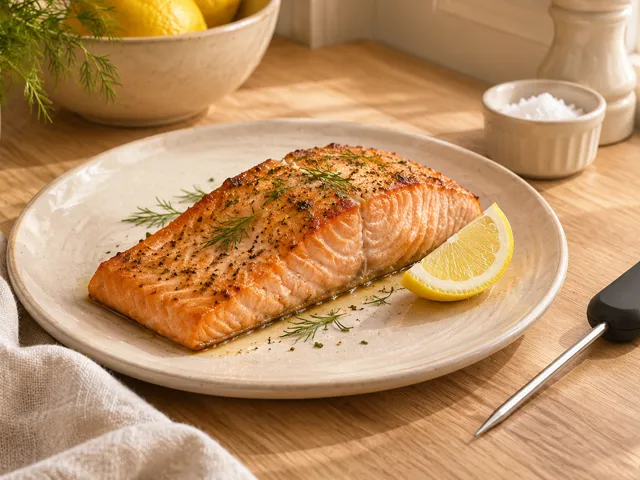
The conversion can't tell you whether chicken is safe. The numbers I use are 165°F (74°C) for poultry, including ground chicken or turkey and poultry sausage, 160°F (71°C) for ground beef, pork or lamb and pork sausage, and 145°F (63°C) for steaks, chops and roasts with a 3-minute rest, or for fish. Choose your food in the calculator and the target appears beside the result. These come from the U.S. safe-minimum chart as published by the University of Maine Cooperative Extension. For the details, the chicken, pork and salmon guides show where to place the probe, because browned skin says nothing about the center. Potatoes are safer ground for practice, and the baked potato guide is a good oven baseline.
Air fryer to oven: reversing the conversion
Set the direction to Air fryer recipe to oven. The calculator adds 25°F and divides the time by 0.8, so 375°F for 16 minutes becomes 400°F for 20 minutes in a conventional oven. It's the same rule run backwards, so the same caution applies: it's a starting point, and the oven's own habits still decide the last few minutes.
FAQ
What is 350°F in an air fryer?
Use 325°F and cut the time by 20%, following KitchenAid’s rule. Twenty minutes in the oven becomes 16. Check early, since air fryers vary.
What is 400°F in an air fryer?
Use 375°F for 20% less time, so 20 minutes becomes 16. Your own air fryer’s booklet takes priority over a general rule.
Does an air fryer cook faster than an oven?
Generally yes, which is why the usual rule cuts both temperature and time. KitchenAid compares air fryers to convection ovens: they move hot air with a fan in a small space. Check early rather than assuming.
Do I convert a convection oven recipe the same way?
I wouldn’t. LG’s ranges, for one, automatically reduce the set temperature by 25°F in convection modes, and a recipe written for a fan oven has, in my reading, already allowed for moving air, so another 25°F could cut twice. The calculator keeps the temperature and takes 20% off the time, which is this site’s estimate.
Do I subtract 25°C when converting Celsius instructions?
No. The rule subtracts a difference of 25°F, about 14°C. The tool converts this for you and rounds to the nearest 5°C.
Can you bake in an air fryer?
You can, but KitchenAid says air fryer heat isn’t ideal for moist or delicate bakes such as cakes or soufflés. I’d look for a recipe written for your appliance, or use the oven.
Basket or oven-style air fryer: does the conversion change?
I found no manufacturer rule that separates them, so the calculator treats them alike. Spread food out so air reaches it, and work in batches rather than crowding.
Does a golden surface mean chicken is ready?
No. Browning says nothing about the center. Use a food thermometer and cook poultry to 165°F (74°C).