Salmon Internal Temperature: Check the Thickest Part
Cook salmon to 145°F (63°C) using a food thermometer in the thickest part. Thin edges finish sooner than a thick center, so check the center deliberately. Lower chef-style targets are not the same as the consumer safety recommendation.
| Situation | What to check | Decision |
|---|---|---|
| Fresh salmon fillet | Thickest center | 145°F / 63°C |
| Several portions | Each thick portion | Do not rely on one piece |
| Thin tail section | Probe from the side if needed | Avoid contact with the pan |
| Cooked salmon leftovers | Reheating temperature | 165°F / 74°C |
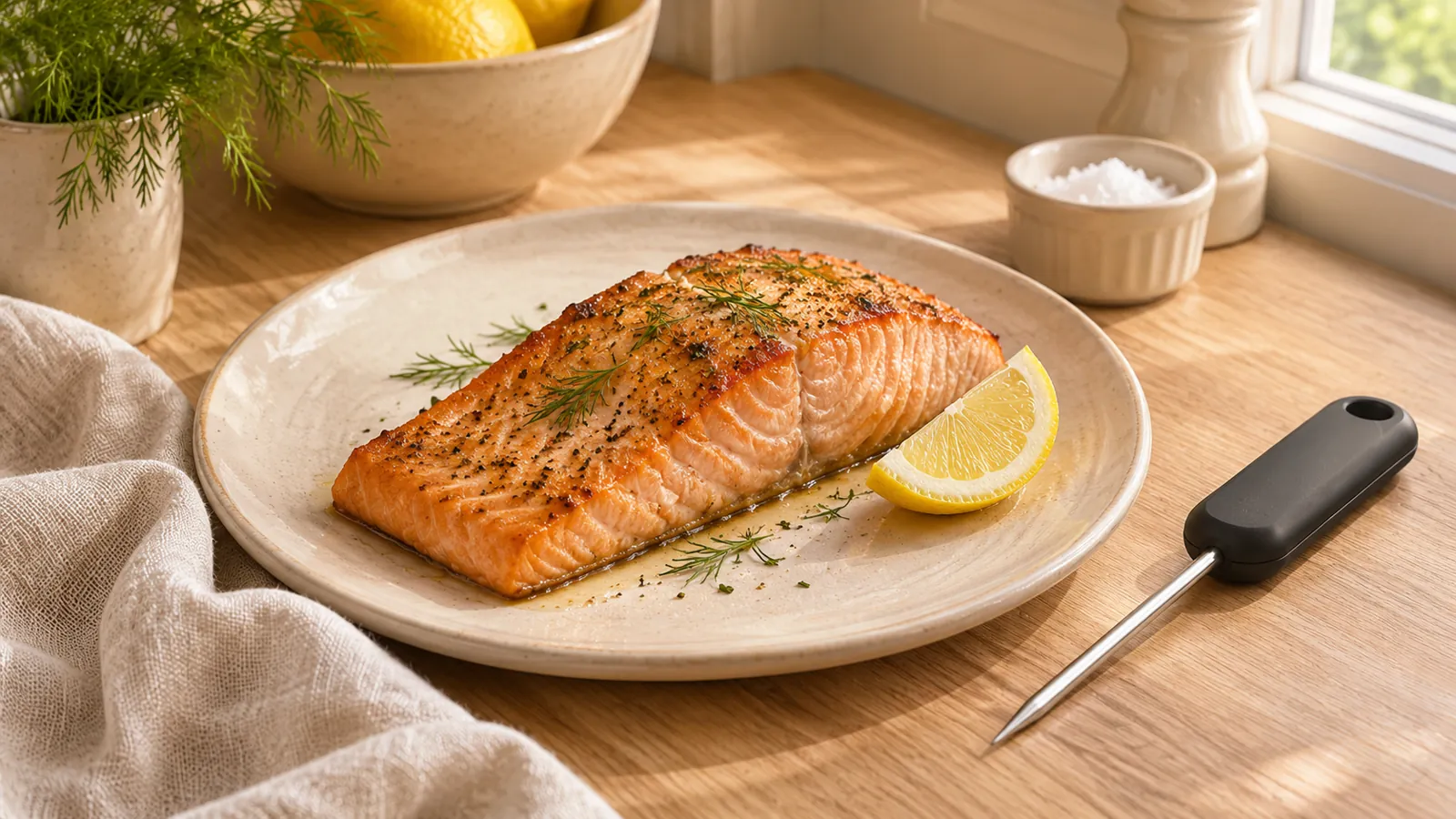
Match thickness, then check each portion
A tray of salmon behaves best when every piece on it is about the same thickness, so that's what I'd arrange for. A thin tail and a thick center cook differently even at the same weight. Check each portion against the 145°F consumer target with careful probe placement, since no exact minute count can account for the fish's shape.
Find the thick part before cooking
A salmon fillet often tapers from a thick center to a thin tail. Take note of that shape when you arrange the pieces, because the part that browns or flakes first may be the part least in need of your attention.
Similar-sized portions are easier to manage together. If one piece is much thinner, I'd plan to check it separately instead of leaving everything in the oven until the largest piece is finished. You want a measured endpoint for each portion, and one timer value for the tray can't give you that.
Position the thermometer inside the flesh
Use a probe suitable for relatively thin food, and enter from the side where that makes it easier to reach the center of the thickest area. Keep the sensing portion inside the flesh, clear of the baking sheet and deeper than just under the surface.
Read the thermometer instructions for insertion depth and response time, then wait for a stable reading. On a piece of fish this slim, I'd assume the probe can go too far. If it has slipped through the fish or is touching the pan, reposition it; a high reading from the wrong location answers nothing.
The tail flakes while the center is still below target
If the thin tail flakes easily but the thick center has not reached 145°F, the center still needs the appropriate check and further cooking. The tail gets no vote on behalf of the whole fillet. With separate portions, I'd move a finished one to a clean plate and keep checking the thicker one.
For a future meal, similar-sized portions can make timing easier. That's a planning choice on my part rather than a new safety rule. With the fish in front of you now, make sure the sensing area is actually inside the thickest flesh and clear of the tray. A probe pressed against a hot pan can deliver a reassuring number that answers the wrong question.
Understand lower culinary targets
Some recipes favor a softer center and recommend a lower temperature. That's a different recommendation from the consumer minimum used here, and I won't describe the two as interchangeable simply because both appear in cooking articles.
This page follows the 145°F target and offers no lower-temperature protocol. People at increased risk of foodborne illness should be especially careful about undercooked seafood. The linked FDA seafood guidance in this page's sources explains the broader handling context.
Flaking and white protein are not thermometer readings
Texture and appearance help you understand the finished dish, and neither one provides an exact internal temperature. White material on the surface is no built-in temperature indicator, and a flaky thin edge says little about a much thicker center.
Use the thermometer for the measured decision. Afterward, I'd jot down how that particular cut and method turned out, since a note about your own fish will help a future cook far more than trying to assign a precise temperature to a photograph of salmon.
Keep the raw and cooked stages separate
Prepare a clean serving plate before the fish is done, because that's a poor moment to go looking for one. Wash utensils or boards that contacted raw fish before using them for cooked portions. Clean the probe according to its instructions after checks. Refrigerate any portions you won't eat soon, following the leftovers guide.
For frozen vacuum-packed fish, follow the package's thawing instructions, including any direction to remove it from the packaging before thawing. I'd read that part of the label before the fish leaves the freezer, since it's the step you can't go back and redo. The storage guide covers that issue in more detail. Reaching a cooking temperature does not replace safe thawing and handling beforehand.
FAQ
Is 125°F the same recommendation as 145°F?
No. Lower temperatures in culinary recipes describe a different texture preference and are below the consumer target used here. This guide recommends 145°F, measured in the thickest part, rather than treating lower endpoints as equivalent safety guidance.
Where do I measure a thin salmon fillet?
Entering from the side can help place the sensing area in the center of the thickest part. Avoid the pan and check the thermometer’s insertion-depth instructions. A probe that passes through the fish may give an irrelevant reading.
Can I stop when the salmon flakes?
Flaking is a useful texture observation, and official guidance includes visual cues, but a thermometer gives a direct measurement. Check the thickest part rather than relying on a thin edge that may finish much earlier than the center.
Does frozen salmon need a different final temperature?
The final consumer target remains 145°F. The cooking method and time may differ, so use a recipe suitable for the starting state and follow package instructions. Safe thawing, especially for vacuum-packed fish, is a separate handling requirement.
Does white material on the surface mean it is overcooked?
Surface appearance alone cannot establish the internal temperature or exactly how the center is cooked. Use a thermometer and assess the finished texture separately. Do not use the amount of white material as a substitute for a measured safety check.