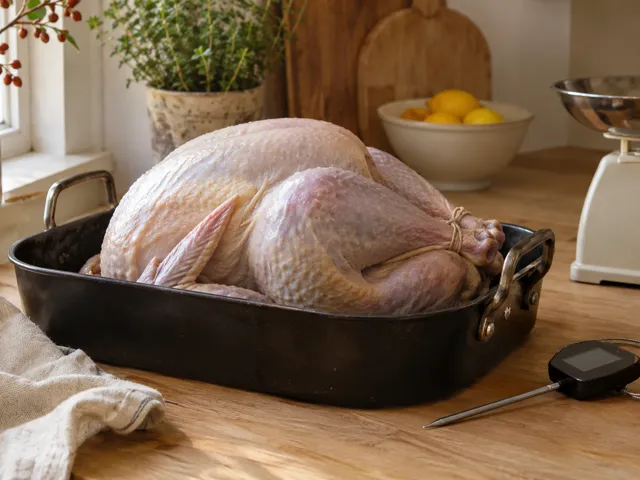
Brine Calculator: How Much Salt per Gallon, in Cups and Grams
Brine calculator
Salt in grams first, then in cups by brand: a cup of table salt and a cup of Diamond Crystal are not the same amount of salt.
USDA FSIS: ¾ cup of table salt per gallon of water, about 216 g or 5.7% of the water. Morton kosher and Diamond Crystal measure differently, so use the salt-brand cups in the result. Keep poultry in the refrigerator, up to 2 days after thawing, and discard the brine.
| Brine | Salt % of water | Salt, grams | Table salt | Morton kosher | Diamond Crystal |
|---|---|---|---|---|---|
| FSIS ratio | 5.7% | 216 g | ¾ cup | about 15 tbsp | 1½ cups |
| Illinois Extension (per gallon) | 7.6% | 288 g | 1 cup | 1¼ cups | 2 cups |
| 5% (a common recipe figure) | 5% | 189 g | about ⅔ cup | about 13 tbsp | about 1⅓ cups |
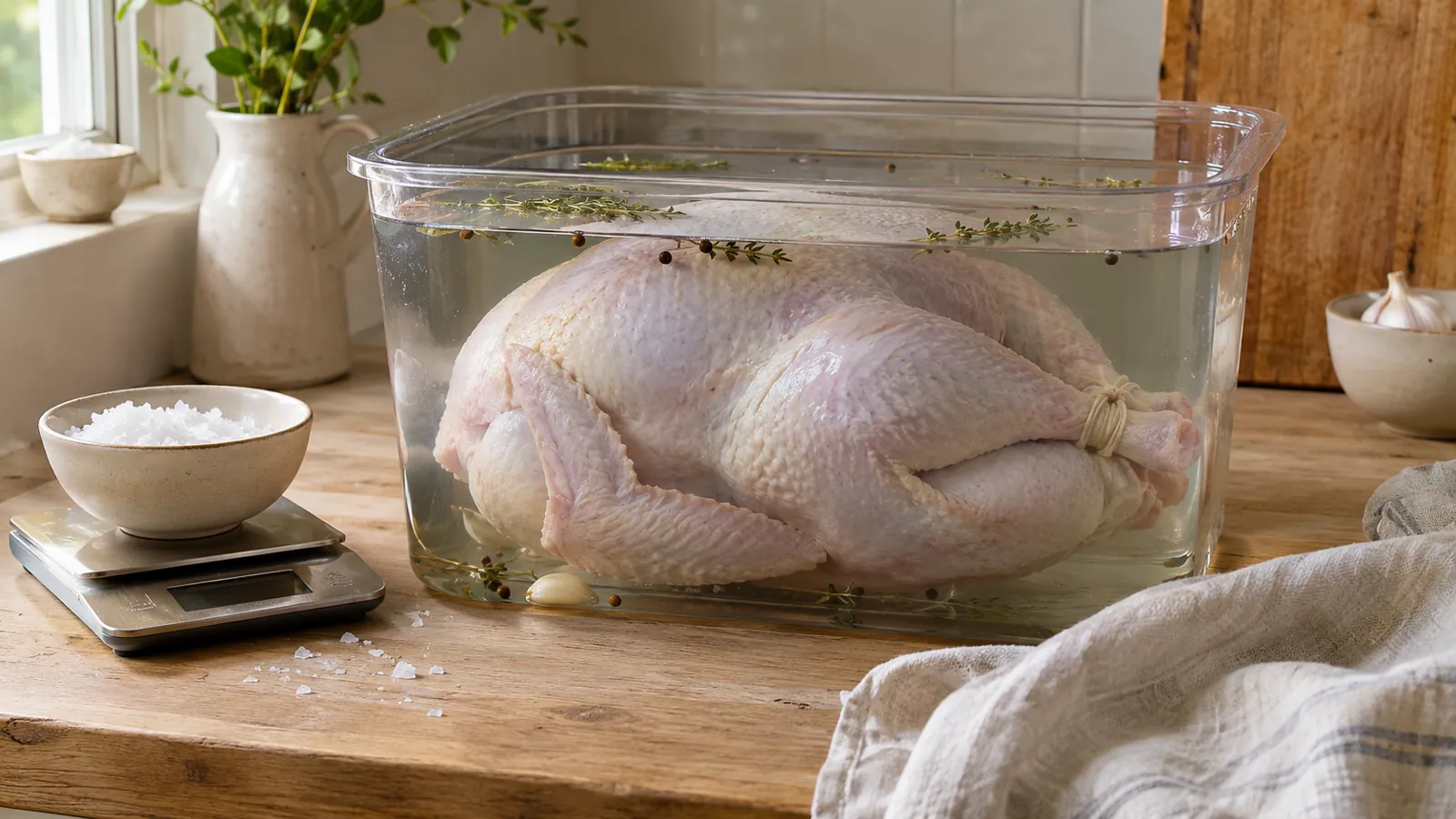
How much salt per gallon of brine?
The USDA Food Safety and Inspection Service gives the ratio I'd start from for poultry: "add ¾ cup salt to 1 gallon of water, or three tablespoons of salt per quart of water", and it specifies "sodium chloride-table salt". Three-quarters of a cup of table salt weighs about 216 grams, using the Morton label's 1.5 grams per quarter teaspoon, so the brine is about 5.7% of the water's weight.
The calculator above turns any of these into your own batch. I'd start with the FSIS ratio if you're brining a whole bird and don't already have a recipe you trust, because it is the US reference. If you want the stronger brine, it comes with a shorter clock.
Morton vs. Diamond Crystal vs. table salt
This is the part most "salt per gallon" answers leave out. Crystals pack differently, so a cup of one salt holds much more salt than a cup of another. Morton's labels give 1.5 g per quarter teaspoon of table salt and 1.2 g for coarse kosher; America's Test Kitchen puts Diamond Crystal at about 3 g per teaspoon. That's roughly 288 g, 230 g and 144 g per cup. Sources don't line up exactly (America's Test Kitchen equates 1 teaspoon of table salt to 1½ of Morton kosher, while the labels give about 1¼), so those are approximate, and grams stay the reference: if you own a scale, use it.
Illinois Extension's turkey brine shows why this matters. It calls for "4 cups kosher salt or 2 cups table salt" in 2 gallons of water, and recommends crystal kosher salt. Four cups of Diamond Crystal is about 576 grams, which does match two cups of table salt. Four cups of Morton kosher is about 920 grams, roughly 60% more salt than the recipe intends. If a recipe says "kosher salt" without naming the brand, I'd treat it as a warning and weigh the salt.
Two ways recipes state a percentage
This calculator expresses salt as a percentage of the water's weight: 5 grams of salt per 100 grams of water at 5%. Some recipes count the percentage of the whole brine, water plus salt. At the FSIS ratio, the same salt reads 5.7% of the water and about 5.4% of the brine. Both appear in the result so that you can match whichever your recipe uses. If a recipe doesn't say, the difference is small.
How much brine for a turkey?
Illinois Extension brines a turkey in 2 gallons. For a 14 lb bird the calculator's meat-weight mode lands near 2.1 gallons: 2 gallons minimum for a turkey, plus a bit more for larger birds. That per-pound scale is this site's estimate, so treat it as a starting point. The surest method is the low-tech one I prefer: put the bird in the brining container, cover it with measured water, and remove the bird. Then discard that water and clean the container before mixing the real brine, since it touched raw poultry. FSIS says to submerge the bird totally, and that test tells you whether the container fits your refrigerator before any salt is involved.
How long to brine, by cut
| Cut | Time | Strength | Source |
|---|---|---|---|
| Whole turkey | At least overnight | FSIS ratio, about 5.7% | USDA FSIS |
| Whole turkey | 6 to 8 hours | Stronger, about 7.6% | Illinois Extension |
| Whole chicken, 3–8 lb | 1 hour | ½ cup table salt per 2 quarts, about 7.6% | America's Test Kitchen |
| Bone-in chicken pieces, 4 lb | ½ to 1 hour | ½ cup table salt per 2 quarts, about 7.6% | America's Test Kitchen |
| Boneless chicken breasts | ½ to 1 hour | 3 tbsp table salt per 1½ quarts, about 3.8% | America's Test Kitchen |
Illinois Extension notes that for an overnight brine you should cut its salt and sugar in half. I read that as the rule the whole table is built on: time and strength move together, so take a time and a percentage from the same source instead of mixing them. FSIS gives the outer limit for poultry: "Poultry may be left in the refrigerator up to 2 days after thawed or purchased fresh." America's Test Kitchen adds that going longer than recommended makes food overly salty. A frozen turkey is not ready for the brine: thaw it in the refrigerator first, and count the 2 days from there.
I couldn't find an official brining time for pork, so this page doesn't invent one. Follow your recipe, and keep the pork refrigerated the whole time.
Keep the brine cold the whole time
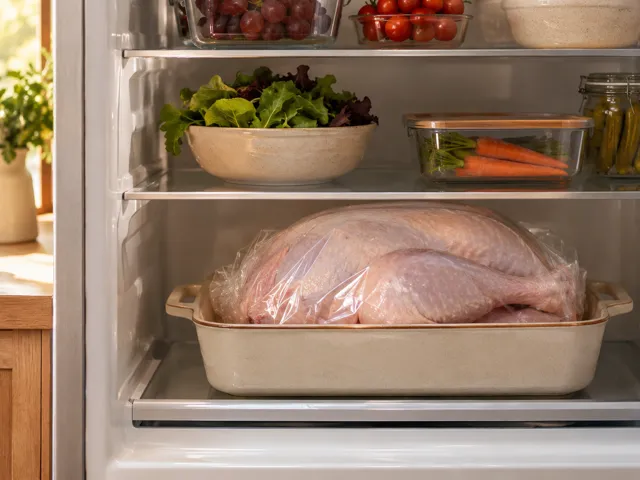
Raw poultry or meat sitting in salty water is still raw meat, and the salt earns it no special treatment. FSIS is direct about both the container and the place: use food-grade plastic, stainless steel or glass, "totally submerge poultry in solution and store covered in the refrigerator". Its washing guidance repeats it: "Meat or poultry should be kept in the refrigerator while soaking." The USDA says this soaking "serves no purpose for food safety", which is worth remembering. It's a flavor technique, and it doesn't excuse skipping any handling step.
Illinois Extension also describes a cooler method, with "5 to 6 ice packs" to keep the turkey and brine at 40°F or below for the entire brining. That's its method, not USDA's. If the bird fits, the refrigerator gets my vote, because it holds the temperature without you watching it. If you do use a cooler, follow Illinois's method exactly and check it with a thermometer.
After the brine: discard, clean, sanitize, cook
FSIS says "Discard brine after use." Its washing guidance tells you how to do that without spreading the mess: "Carefully pour out the soak and do not reuse it. Wash the container you used for the soak or sanitize it in the dishwasher. Clean and then sanitize your inner sink and any surfaces that touch the used soak."
On rinsing, the sources split. Illinois Extension rinses the turkey after brining; USDA warns that washing raw poultry can splash bacteria around the kitchen. I side with USDA: skip the rinse, pat the bird dry with paper towels, and sanitize the area as above.
Brining never changes the safe temperature. Poultry, whole or in pieces, goes to 165°F, checked with a food thermometer. Pork chops and roasts go to 145°F with a 3-minute rest, and ground pork to 160°F, per the FoodSafety.gov chart. FSIS is direct on stuffing: "For optimum safety, do not stuff whole poultry." If you stuff one anyway, it says to brine first, cook immediately after stuffing, and bring the center of the stuffing to 165°F.
Check the label before you brine
Read the label first. FSIS explains that if you see "self-basting", "marinated" or "for flavoring" on raw poultry, a solution of butter or other fat, broth, stock or water plus flavorings has been added during processing, up to 3% of the weight for bone-in poultry and 8% for boneless. A bird like that has already been treated, so check the sodium on the label before you add a brine. Kosher poultry is a separate case: a reader question published by the Orthodox Union notes that koshering covers the meat with salt for an hour and that kosher meat and poultry run higher in sodium. I can't think of a reason to salt the same bird twice, so for a kosher bird I'd reach for a seasoning rub instead.
Brine or dry brine?
FSIS also describes dry brining: 1 tablespoon of kosher or seasoned salt for every 5 pounds of poultry, rubbed over the surface, in a food-grade bag in the refrigerator for up to 2 days. I'd choose it when a brining container doesn't fit in the fridge, since it asks for no bucket and no water at all.
Limits of this calculator
It handles wet brines only. Curing with nitrite salts and pickling vegetables follow their own tested recipes, so I'd go to those directly. For the whole turkey plan, the turkey calculator covers buying, thawing and roasting,.
FAQ
How much salt per gallon for a turkey brine?
USDA FSIS calls for ¾ cup of table salt per gallon of water, about 216 grams and 5.7% of the water. Illinois Extension’s stronger recipe is 1 cup of table salt per gallon, used for a shorter 6 to 8 hours.
Can I use Morton or Diamond Crystal instead of table salt?
Yes, but not cup for cup. A cup of table salt is roughly 288 grams, Morton kosher 230 and Diamond Crystal 144, from Morton’s labels and America’s Test Kitchen. Use the salt-specific cups in the calculator, or weigh the salt. Grams never change.
How long should I brine a 14 lb turkey?
USDA FSIS says at least overnight at its ratio, and that poultry may stay in the refrigerator up to 2 days after thawed or purchased fresh. Illinois Extension’s stronger brine is 6 to 8 hours. Take the time from the same source as the salt strength.
Do I need to keep brine in the refrigerator?
Yes. FSIS says to submerge poultry completely and store it covered in the refrigerator. Illinois Extension also describes a cooler with 5 to 6 ice packs holding the turkey and brine at 40°F or below; the refrigerator is the method I’d choose.
Can I brine a frozen turkey?
FSIS gives its 2-day refrigerator limit as starting after poultry is thawed or purchased fresh, so thaw first, in the refrigerator, and then brine.
Can I brine a self-basting or kosher turkey?
Check the label first. FSIS says terms like “self-basting”, “marinated” or “for flavoring” mean a solution was added during processing (up to 3% by weight bone-in, 8% boneless). A reader question published by the Orthodox Union notes kosher poultry is salted during koshering. Check the sodium on the label, and I’d use a seasoning rub on a kosher bird.
Can I reuse brine?
No. FSIS says to discard brine after use. Wash the container or sanitize it in the dishwasher, then clean and sanitize your sink and any surfaces the used brine touched.
Does brining change the cooking temperature?
No. Poultry still goes to 165°F. Pork chops and roasts go to 145°F with a 3-minute rest, and ground pork to 160°F, per the FoodSafety.gov chart.
Sources
- USDA FSIS — Poultry: Basting, Brining, and Marinating
- USDA FSIS — Washing Food: Does It Promote Food Safety?
- FoodSafety.gov — Safe minimum internal temperatures
- Illinois Extension — Brine Method
- America’s Test Kitchen — How to Salt and Brine Chicken
- America’s Test Kitchen — The Wrong Kind of Salt Could Ruin Your Dinner
- Morton Salt — Iodized table salt nutrition label
- Morton Salt — Coarse kosher salt nutrition label
- Orthodox Union — Kosher meat salting