Pizza Dough Calculator
Pizza dough calculator
Scale a flour–water–salt–yeast dough by weight. Copy percentages from a formula you trust; oil, sugar and preferments are not included.
Choose the number and weight of your dough balls, then enter your formula’s baker’s percentages. The calculator returns ingredient weights in grams; it scales a formula rather than predicting fermentation.
| Ingredient | Baker's percentage | What it means |
|---|---|---|
| Flour | 100% | The reference weight |
| Water | 65% | 65 grams per 100 grams of flour |
| Salt | 2.5% | 2.5 grams per 100 grams of flour |
| Yeast | 0.2% | 0.2 grams per 100 grams of flour |
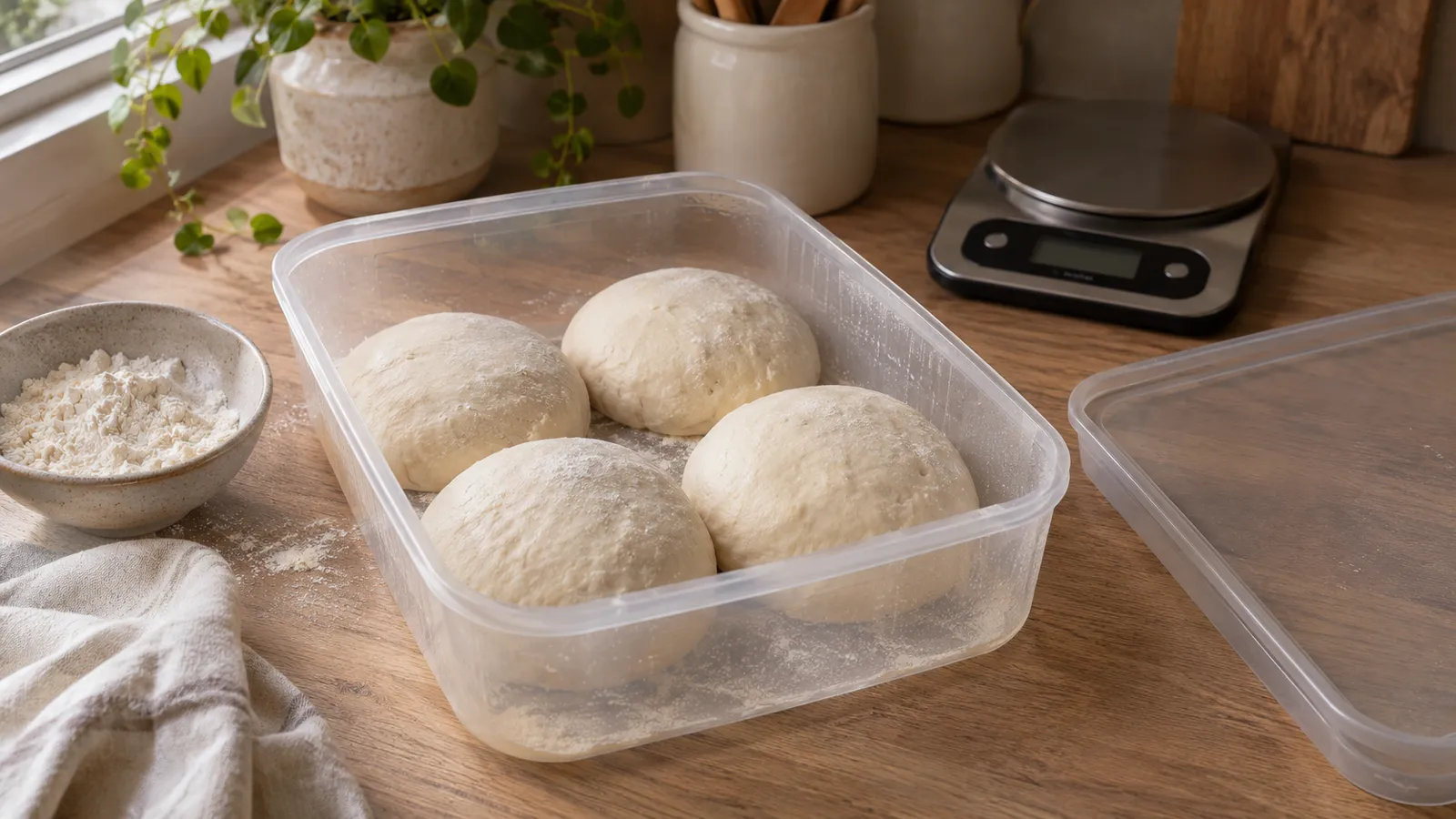
Choose the amount of dough before choosing the flour
This calculator works backward from the dough you want to end up with. Enter the number of balls, the weight of each ball, and the ingredient percentages from your dough formula. It returns the flour, water, salt, and yeast weights that add up to the requested total.
That solves a common scaling problem. If you start with an arbitrary bag of flour, you may make far more dough than you need. If you start with four dough balls at 250 grams each, you have a clear target: 1,000 grams of dough. The calculator divides that target among the ingredients instead of treating the flour weight as the finished weight.
What baker's percentages mean
Baker's percentages describe every ingredient as a share of the flour weight, and the flour always counts as 100%. A formula with 65% water therefore uses 65 grams of water for every 100 grams of flour, whatever the batch size. Because each ingredient is compared with the flour rather than with the finished dough, the percentages add up to more than 100%: the example below totals 167.7%.
That total is what makes scaling simple. Divide the dough weight you want by the total, expressed as a decimal, to get the flour, then multiply the flour by each percentage. For four 250-gram dough balls, 1,000 grams divided by 1.677 gives about 596 grams of flour, then about 388 grams of water, 15 grams of salt, and 1.2 grams of yeast. I prefer this way of writing a dough because the ratios stay readable when you change the number of pizzas; a recipe written in cups hides them. The calculator above runs the same arithmetic, so you can check one result by hand and trust the rest.
Scale a formula before changing it
I recommend using this tool to answer a quantity question: how much of each ingredient is needed for these dough balls? Start with a dough formula you trust. The example yeast percentage is not a fermentation schedule; correct arithmetic cannot make unsuitable percentages fit your flour, room temperature, or available time.
These percentages are not portions of the finished dough. Their total can exceed 100% because flour is the reference for every other ingredient. Hydration is the water weight divided by flour weight, multiplied by 100. A 65% hydration dough does not contain 65% water by total weight.
The defaults demonstrate the arithmetic. They are not a promise that a particular yeast amount will suit your room temperature, flour, or fermentation schedule. Take the percentages from a complete dough formula that matches how you plan to handle the dough.
Worked example: four dough balls
Four balls at 250 grams require 1,000 grams of dough. At 65% water, 2.5% salt, and 0.2% yeast, divide 1,000 by 1.677. The result is approximately 596.3 grams of flour. That gives approximately 387.6 grams of water, 14.9 grams of salt, and 1.2 grams of yeast.
The sum is about 1,000 grams, allowing for displayed rounding. This is the check to perform if you scale a formula by hand: add every ingredient, not just flour and water. Small ingredients still contribute to the total.
Worked example: two larger balls
Two balls at 300 grams need 600 grams of dough. Keep the same percentages and every ingredient becomes 60% of the first example: approximately 357.8 grams of flour, 232.6 grams of water, 8.9 grams of salt, and 0.7 grams of yeast.
Notice what changed and what did not. The ingredient ratios stayed the same, but the quantity fell. The calculator does not conclude that fermentation should take 60% as long. Scaling ingredient mass and predicting fermentation are different jobs.
Six people do not automatically mean six identical pizzas
Start with the number of dough balls and their intended weight, based on the recipe and serving plan you are actually using. Six balls at 250 g mean 1,500 g total dough; four balls at 300 g mean 1,200 g. Entering a guest count alone would hide that choice.
I would choose the ball weight before adjusting hydration, rather than change hydration to make the final total come out neatly. If your formula includes oil, sugar, a preferment, or another ingredient outside this four-ingredient model, this calculator does not describe the full dough mass. Use a calculator or spreadsheet that includes those ingredients. A precise-looking number is useful only when everything that belongs in the total is actually included.
Hydration is not a quality score
A larger hydration number is not automatically a better pizza. Your flour, mixing method, handling experience, and oven all affect which dough is practical. Increasing the water can change how sticky the dough feels and how easily it moves from the work surface to the oven.
When learning a new formula, hold the hydration steady long enough to understand the dough. Adding flour during shaping also changes the formula, even if that flour never entered the calculator. Measure what you can and keep notes about what you changed.
Yeast type and fermentation time
Select the yeast type used by your source formula, then enter that formula's percentage. The selector labels the result; it does not silently convert instant yeast to active dry or fresh yeast. Follow the product's instructions for use and any conversion guidance supplied by the manufacturer.
A single “hours of proofing” input would hide important variables. Dough temperature, refrigerator temperature, room conditions, and the yeast product can all affect the schedule. For that reason this version scales a known formula instead of inventing a fermentation model from the clock alone.
Small yeast quantities also expose the limits of a kitchen scale. A display that changes only in whole grams cannot reliably measure a fraction of a gram. Use a scale appropriate to the quantity or a formula designed for a larger batch; do not interpret a precise-looking calculator result as a promise that your equipment can weigh it.
Why the output uses grams
Volume measurements introduce another variable, especially for flour. A cup scooped firmly from a bag can contain more flour than a lightly filled cup. Salt crystal sizes also differ, making a generic spoon conversion misleading. Weights keep the scaling arithmetic transparent. If your source formula lists flour in cups, the cups to grams converter gives a weight to start from.
This tool covers a four-ingredient dough. If your formula contains oil, sugar, milk, sourdough starter, or a preferment, those ingredients must be included in a more complete formula calculation. Adding them after using this tool increases total dough weight and may change hydration. Do not squeeze a complicated dough into a simpler model just because the form is convenient.
FAQ
Is hydration the percentage of water in the finished dough?
No. Baker’s hydration expresses water as a percentage of flour weight. With 1,000 grams of flour and 650 grams of water, hydration is 65%. Salt and yeast add further mass. That is why the sum of baker’s percentages is greater than 100%.
Can I enter fresh yeast instead of instant yeast?
Yes, if you enter the percentage specified for fresh yeast by your source formula. Choosing the yeast type changes the output label, not the amount automatically. Use manufacturer guidance when converting yeast types; do not assume the same percentage applies to every form.
Does the calculator tell me how long to proof the dough?
No. It scales ingredient weights. Fermentation also depends on temperature, yeast, flour, and handling, so a credible schedule needs more than a total dough weight. Follow the schedule from your complete source formula and adjust based on its instructions and your actual conditions.
Can I add oil or sourdough starter to the result?
Adding ingredients increases the total weight and may change hydration. This version covers only flour, water, salt, and yeast. Use a fuller formula calculation for oil, sugar, milk, or preferments rather than adding them afterward and assuming the requested ball weights still match.
Why are there no cup measurements for flour and salt?
Cup measurements depend on how flour is filled and on the ingredient’s density. Salt crystal size varies too. Gram weights keep the arithmetic consistent. Use a scale suitable for the smallest quantity, especially when the yeast amount is less than a gram.