Cooking Conversion Chart and Calculator
Cooking conversion calculator
1 US cup equals 16 tablespoons, 48 teaspoons, 8 fluid ounces or about 236.59 mL. Enter any amount above to get every equivalent, plus a plan for measuring it with the cups and spoons you own.
| Measure | Tablespoons | Teaspoons | Fluid ounces | Milliliters |
|---|---|---|---|---|
| ⅛ cup | 2 | 6 | 1 | 29.57 |
| ¼ cup | 4 | 12 | 2 | 59.15 |
| ⅓ cup | 5⅓ | 16 | 2⅔ | 78.86 |
| ½ cup | 8 | 24 | 4 | 118.29 |
| ⅔ cup | 10⅔ | 32 | 5⅓ | 157.73 |
| ¾ cup | 12 | 36 | 6 | 177.44 |
| 1 cup | 16 | 48 | 8 | 236.59 |
| 1 pint (2 cups) | 32 | 96 | 16 | 473.18 |
| 1 quart (4 cups) | 64 | 192 | 32 | 946.35 |
| 1 gallon (16 cups) | 256 | 768 | 128 | 3,785.41 |
How to convert cups, tablespoons and ounces
Knowing that a cup holds 16 tablespoons is the easy part. The awkward moment comes when a recipe asks for 7 tablespoons and you're standing over the bowl with a set of cups and a single spoon. So I built this around the question that follows the arithmetic: which of the things in your drawer should you pick up?
Enter any amount, choose its unit, and the result gives you the equivalent measures along with a plan for scooping it. Seven tablespoons becomes ¼ cup plus 3 tablespoons. A ⅓ cup stays a ⅓ cup, even if you arrived asking about 5⅓ tablespoons. You can type 1/3, 1 1/2, ⅔ or 0.75, or tap the fraction buttons if your phone keyboard makes a slash hard to reach.
How to measure with the spoons you own
Standard American sets usually have 1, ½, ⅓ and ¼ cup measures, so those start out ticked along with the common spoons. Untick anything you've lost or never owned and the plan rebuilds itself using only what remains. If you bought a ¾ cup or a ⅛ teaspoon, tick it and the plan will use it when that means fewer scoops.
The plan always aims for the fewest scoops, because every extra level-off is another chance to drift. When your set can't reach an amount exactly, you'll see the nearest one you can measure and how far off it is, in percent. I'd rather show a small, stated error than hand you a tidy fraction that quietly isn't true. A rounded ½ cup for 7 tablespoons, for example, is a 14% overshoot, and in a cake batter that's a real difference.
Is a cup 236.59 mL or 240 mL?
A US customary cup is 8 fluid ounces, about 236.59 mL. NIST Handbook 44 defines the measuring cup as 8 fluid ounces and prints it rounded as 237 mL. The FDA's guidance on household measures uses a different convention for nutrition labels, set out in 21 CFR 101.9: 1 cup means 240 mL, 1 tablespoon 15 mL, 1 teaspoon 5 mL and 1 fluid ounce 30 mL. NIST's kitchen table also lists rounded pairs and calls them approximate equivalents for home cooking.
Neither figure is wrong; they serve different jobs. The gap is about 1.4%, which won't matter in soup. I use the customary value for the conversion because that's what your American measuring cup holds, and I show the label figure on its own line so you can recognize it when a package disagrees with you.
Fluid ounces vs. ounces by weight
A fluid ounce measures space. An ounce on a scale measures weight. They only line up for water and ingredients close to it, so eight ounces of flour by weight comes nowhere near a cup. That's why the converter won't turn a weight into a volume until you name the ingredient. It would be easy to return a number anyway, and it would be the wrong number for nearly everything in your pantry.
Choose an ingredient and you'll also get grams and ounces by weight, using the King Arthur Baking ingredient chart. I'd spoon flour into the cup and level it, because packing it straight from the bag changes what the cup holds. If you bake often, I think weighing beats every cup in this table, and the cups to grams converter is the better starting point when weight is all you need. For a whole ingredient list rather than one line, use the recipe scaler.
How many sticks of butter are in a cup?
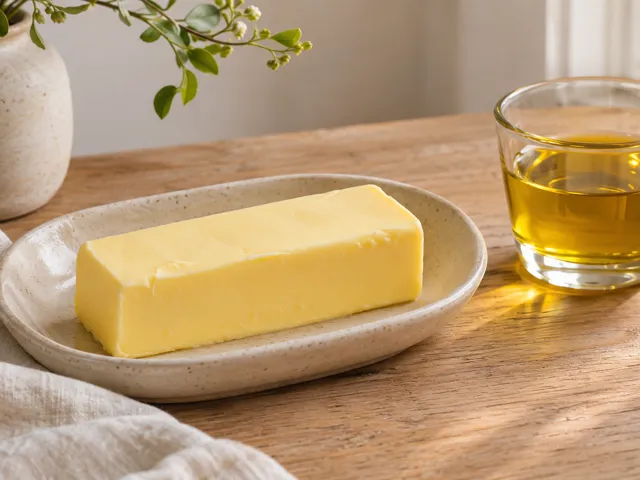
American butter is sold in sticks, and one stick is ½ cup, or 8 tablespoons. Choose butter as the ingredient and the result adds sticks to the list, so ¾ cup reads as 1½ sticks, 12 tablespoons and about 170 grams. It's the conversion I'd want on hand most often, since the wrapper's markings do the measuring for you.
Converting large amounts: quarts and gallons
Past 16 cups, a plan made of individual scoops stops being helpful, so the tool switches to quarts and suggests a large liquid measure. For anything that size, the small errors of repeated scooping add up, and a single large container is both faster and more even.
FAQ
How many tablespoons are in a cup?
There are 16 tablespoons in 1 US cup, so ½ cup is 8 tablespoons, ¼ cup is 4 and ⅓ cup is 5⅓. The fraction is exact: 5 tablespoons plus 1 teaspoon.
How do I measure 7 tablespoons?
Use a ¼ cup measure, which holds 4 tablespoons, and add 3 tablespoons. Rounding to ½ cup would add about 14% more than the recipe asks for.
Is a fluid ounce the same as an ounce?
No. A fluid ounce measures volume and an ounce measures weight. An ingredient has to be named before one can be converted to the other, because a cup of flour and a cup of honey weigh very different amounts.
Why do some labels say a cup is 240 mL?
FDA nutrition labeling defines 1 cup as 240 mL. The US customary cup is 8 fluid ounces, about 236.59 mL. The difference is about 1.4%, and the converter shows both.
How many sticks of butter are in a cup?
Two. One US stick is ½ cup, or 8 tablespoons, so 1 cup is 2 sticks and ¾ cup is 1½ sticks.
Does the converter remember my measuring spoons?
Yes, on the device you are using. The choice is stored in your browser and is not sent to the site, so you will need to set it again on another phone or computer.