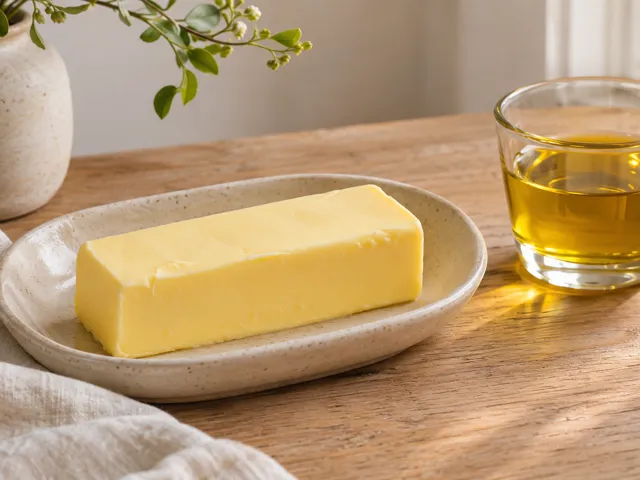
How Many Sticks of Butter in a Cup?
How many sticks of butter in a cup?
2 US sticks of butter make 1 cup. Each stick is ½ cup, so doubling the number of cups gives you the number of sticks: ¾ cup is 1½ sticks and 1½ cups is 3 sticks.
| Cups | Sticks | Tablespoons | Grams (approx.) |
|---|---|---|---|
| ¼ | ½ | 4 | 57 |
| ⅓ | ⅔ | 5⅓ | 76 |
| ½ | 1 | 8 | 113 |
| ⅔ | 1⅓ | 10⅔ | 151 |
| ¾ | 1½ | 12 | 170 |
| 1 | 2 | 16 | 227 |
| 1¼ | 2½ | 20 | 283 |
| 1½ | 3 | 24 | 340 |
| 1¾ | 3½ | 28 | 397 |
| 2 | 4 | 32 | 454 |
How many sticks is ¾ cup of butter?
One and a half. Recipes are written in cups, the fridge is stocked in sticks, and the bridge between them is one line of arithmetic: double the cups. A quarter cup is half a stick, 1¼ cups is 2½ sticks, and 1¾ cups is 3½. No measuring cup needs to get greasy, and packing one means chasing air pockets with a spatula for a less exact amount than the stick already gave you.
Thirds are the exception, because the tablespoon marks on a stick don't land on them. A ⅓ cup is ⅔ of a stick, or 5 tablespoons plus 1 teaspoon. A ⅔ cup is 1⅓ sticks, which works out to a whole stick plus 2 tablespoons and 2 teaspoons. The third-of-a-cup page goes through that one in detail, and for the cuts themselves, see tablespoons in a stick of butter.
Butter that doesn't come in four sticks
A solid 1-pound block is the same 2 cups as four sticks, just with no marks on it, and it cuts the way anything cuts: one slice down the middle is 1 cup, half of that piece is ½ cup, and half again is ¼ cup. For ¾ cup, set a ½ cup piece beside a ¼ cup piece. An 8-ounce block is 1 cup, or 2 sticks' worth, and halving it once gets you ½ cup.
A 250-gram block, the size you may meet on an import shelf, doesn't play along with any of this. It's 250 divided by 113, about 2.2 sticks or 1.1 cups, so no halving lands on a US measure. Take 1 cup from it and 23 grams stay behind, about 1½ tablespoons. That's the one case on this page where I'd put the block on a scale and read 113 grams for ½ cup, 170 for ¾ cup and 227 for a cup, because cutting a block by eye to 45% or 68% of its length is a guess.
Add up every butter line before you shop
Recipes rarely put all their butter on one line. A cake that uses 1 cup and a frosting that uses ¾ cup come to 1¾ cups, which is 3½ sticks, and a four-stick box covers it with half a stick to spare. Double that same cake and you're at 3½ cups, or 7 sticks, so one box won't do and two leave you a single stick. Leave out any "butter for the pan" line when you count, since that's measured by whatever is on the wrapper you've got open. The sum takes about five seconds and it's a good deal cheaper than a second trip.
Lines that mix cups and spoons
"Double the cups" stops working when a line says 1 cup plus 2 tablespoons, and for those I'd go through tablespoons. Multiply the cups by 16, add the spoons, then divide by 8: the whole number is sticks, and the remainder is tablespoons on the next wrapper. So 1 cup plus 2 tablespoons is 18 tablespoons, which is 2 sticks and 2 tablespoons. A line for ⅔ cup plus 1 tablespoon is 11⅔ tablespoons, which is 1 stick plus 3 tablespoons and 2 teaspoons. And a recipe calling for "1 cup less 2 tablespoons" wants 14: two whole sticks with 2 tablespoons sliced off the second.
The preset above is set to butter and leads with sticks. Type ¾ or 1 1/4 and you'll see sticks, tablespoons, grams and ounces by weight together, plus a measuring plan from whatever you've ticked; untick the cups if you'd rather see spoons, though with a wrapper in front of you the plan is optional. Milk, sugar or anything else that isn't butter on the same card goes through the general conversion calculator instead.
Salted, unsalted, and recipes in ounces
The count stays the same: 2 sticks to the cup either way. What moves is the salt in the rest of the recipe. King Arthur's recipe success guide uses an adjustment of about ¼ teaspoon of salt per 8 tablespoons of butter, which is per stick. So if a recipe specifying unsalted butter gets salted butter instead, 1 cup, or 2 sticks, points to about ½ teaspoon less added salt. For ¾ cup, it's about ⅜ teaspoon. Brands differ, so treat that as a starting point, and never take out more salt than the recipe contains. Our butter substitute guide has more on that, and on spreads and tubs, which aren't always the same thing as butter.
Recipes that give butter by weight are easier still: one stick is 4 ounces and 113 grams, so 8 ounces is 2 sticks and 170 grams is 1½. If you ever want butter side by side with other ingredients, the page on cups in a pound has it.
FAQ
How many sticks of butter is ½ cup?
One stick. One US stick is exactly ½ cup, or 8 tablespoons.
How many sticks are in a 1-pound block of butter?
Four sticks' worth, or 2 cups. A block has no wrapper marks, so halve it for 1 cup and halve again for ½ cup.
How many sticks is 250 grams of butter?
About 2.2 sticks, or 1.1 cups, at 113 grams per stick. That's 2 sticks plus about 24 grams.
How do I measure ⅔ cup of butter from sticks?
Use 1 whole stick plus 2 tablespoons and 2 teaspoons from a second one.
How many sticks is 1 cup plus 2 tablespoons of butter?
That's 18 tablespoons: 2 full sticks and 2 tablespoons from a third.
How many grams are in 2 sticks of butter?
About 227 grams, which is 8 ounces.