Turkey Calculator: Size, Thawing and Roasting Time
Turkey calculator
How big a turkey to buy, how long to thaw it and how long to roast it at 325°F. Based on Illinois Extension buying guidance and the USDA timetable for whole turkeys.
Plan about 1 lb of whole turkey per guest, or 1½ lb for hearty eaters and leftovers. Thaw it in the refrigerator about one day per 4–5 lb, and roast a 12–14 lb unstuffed bird about 3 to 3¾ hours at 325°F, until a thermometer reads 165°F.
| Turkey weight | Feeds (1 lb per guest) | Refrigerator thawing | Unstuffed roasting | Stuffed roasting |
|---|---|---|---|---|
| 8–12 lb | 8–12 | 1½–3 days | 2¾–3 hours | 3–3½ hours |
| 12–14 lb | 12–14 | 2½–3½ days | 3–3¾ hours | 3½–4 hours |
| 14–18 lb | 14–18 | 3–4½ days | 3¾–4¼ hours | 4–4¼ hours |
| 18–20 lb | 18–20 | 3½–5 days | 4¼–4½ hours | 4¼–4¾ hours |
| 20–24 lb | 20–24 | 4–6 days | 4½–5 hours | 4¾–5¼ hours |

Turkey planning at a glance
Start from the guest list, not the turkey
Most turkey mistakes begin at the store. A bird bought on impulse decides the thawing date, the oven schedule and sometimes the size of the roasting pan. I prefer to work backward: count the guests, choose a weight, then count the days needed to thaw it. The calculator follows that order.
Illinois Extension suggests buying about one pound of whole turkey per person, or a pound and a half if your guests are hearty eaters or you want plenty of leftovers. That weight includes bones, so it is not the amount of meat on each plate. For most tables I would pick the standard setting when the menu has several substantial sides, and the larger setting when turkey sandwiches the next day are part of the plan.
Worked example: ten guests
Ten guests at one pound each means a turkey of about ten pounds. Using the refrigerator rule of roughly one day per four to five pounds, it needs two to two and a half days to thaw, so I would move it from the freezer to the refrigerator at least three days before cooking. Unstuffed, the USDA timetable gives about 2¾ to 3 hours at 325°F.
The same ten guests at a pound and a half each call for a fifteen-pound bird. That is not just a bigger number: thawing now takes three to four days, and roasting moves to about 3¾ to 4¼ hours. If your oven is also needed for side dishes, that extra hour matters more than the extra five pounds.
Thawing is where the calendar slips
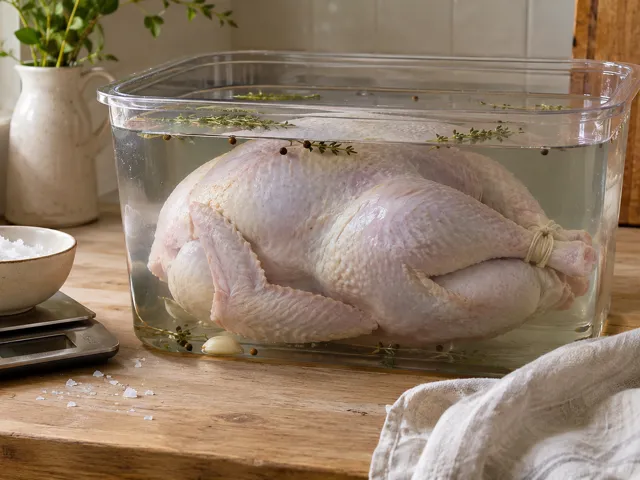
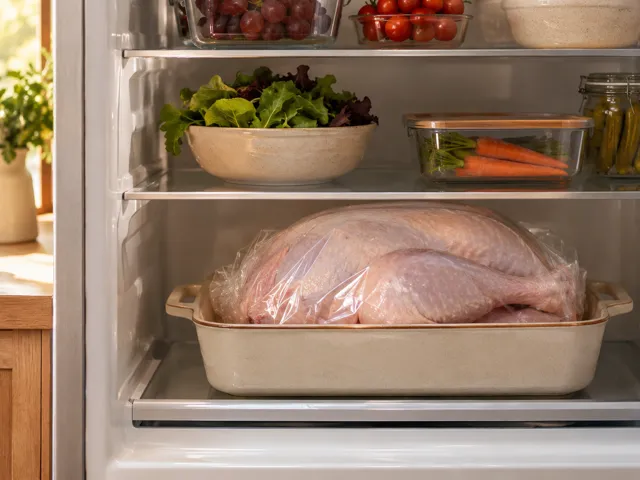
USDA lists the refrigerator as the safest way to thaw a turkey: allow about 24 hours for every four to five pounds, with the refrigerator at 40°F or below. A thawed bird can then wait one to two more days in the refrigerator, which gives you a small buffer. I recommend that method whenever the calendar allows it.
Cold water is faster, at about 30 minutes per pound, but it is an attended job: the turkey stays in leakproof wrapping, the water is changed every 30 minutes, and the bird is cooked immediately afterward. For a fifteen-pound turkey that is seven and a half hours of water changes. If you cannot stay in the kitchen, the faster method is not the better one. Our turkey thawing guide covers both methods in detail.
Roasting times are estimates; the thermometer decides
The timetable assumes a fresh or fully thawed bird in a conventional oven set to 325°F. Oven accuracy, the starting temperature of the bird, the pan and how often the door opens all change the real time. Use the range to plan when the turkey goes in, then check with a food thermometer before the earliest time.
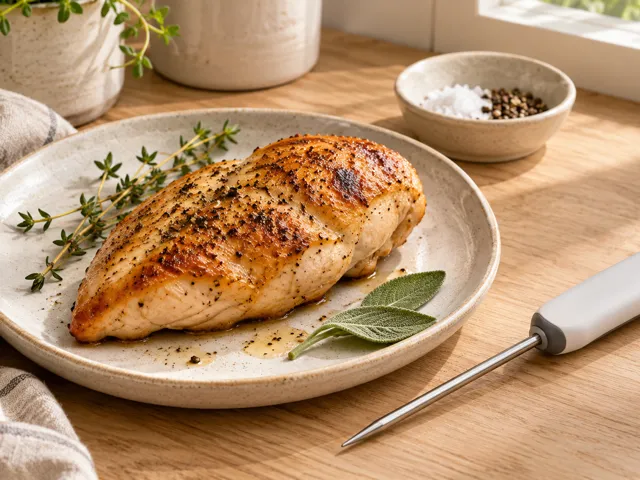
The safe minimum is 165°F. Check the innermost part of the thigh and wing and the thickest part of the breast. If the turkey is stuffed, the center of the stuffing must also reach 165°F. That last point is why I lean toward baking stuffing in a separate dish: the bird cooks a little faster, and you do not have to wait for the stuffing to catch up after the meat is done.
When the calculator says your turkey is small
For four or five guests, the arithmetic suggests a bird under eight pounds, below the smallest whole-turkey row of the USDA timetable. Whole turkeys that small are hard to find. A bone-in turkey breast, at about half a pound per person according to Illinois Extension, is often the more practical choice for a small table, and it fits in a smaller oven alongside the sides.
At the other end, the USDA timetable stops at 24 pounds. For a very large group I would consider two medium birds rather than one giant one: each thaws and roasts on a shorter schedule, and a delay with one does not hold up the whole meal.
What this calculator does not do
It does not plan a smoked, fried or spatchcocked turkey, which follow different timings, and it does not adjust for convection ovens. It does not replace the instructions printed on a pre-stuffed or specialty product. Its job is to put the buying, thawing and roasting numbers on one screen, so you can see the schedule before the bird is in your cart.
FAQ
How much turkey do I need per person?
About one pound of whole turkey per guest, according to Illinois Extension, or a pound and a half if your guests are hearty eaters or you want leftovers. The weight includes bones, so it is not the cooked meat per plate.
How long does a 20 lb turkey take to thaw?
In the refrigerator, about four to five days, using the USDA allowance of 24 hours per four to five pounds. In cold water changed every 30 minutes, about ten hours, and the bird must be cooked immediately afterward.
How long do I cook a 15 lb turkey at 325°F?
The USDA timetable gives about 3¾ to 4¼ hours unstuffed and 4 to 4¼ hours stuffed. Start checking before the earliest time; the turkey is done when a food thermometer reads 165°F in the thigh, wing and thickest part of the breast.
Is it better to cook the stuffing inside the turkey?
You can, but the stuffing must also reach 165°F, which can keep the bird in the oven longer. I prefer baking it in a separate dish: the turkey cooks on a simpler schedule and the stuffing gets a crisp top.
Does the calculator work for a convection oven or a smoker?
No. The times come from a conventional-oven timetable at 325°F. Convection ovens, smokers, fryers and spatchcocked birds follow different timings; use the appliance or recipe instructions and a thermometer.