Boiled Egg Timer
Boiled egg timer
| Soft | |
|---|---|
| Jammy | |
| Medium | |
| Hard |
For large refrigerated eggs lowered into boiling water, start at about 6 minutes for soft, 7 for jammy, 9 for medium and 12 for hard. Only firm white and yolk meets the FDA recommendation; above 2,000 feet, allow more time and check.
| Yolk | Large | Extra-large | What to expect |
|---|---|---|---|
| Soft | 6:00 | 6:30 | White set, yolk runny |
| Jammy | 7:00 | 7:35 | Yolk thick but not firm |
| Medium | 9:00 | 9:45 | Mostly set with a softer center |
| Hard | 12:00 | 13:00 | White and yolk firm throughout |
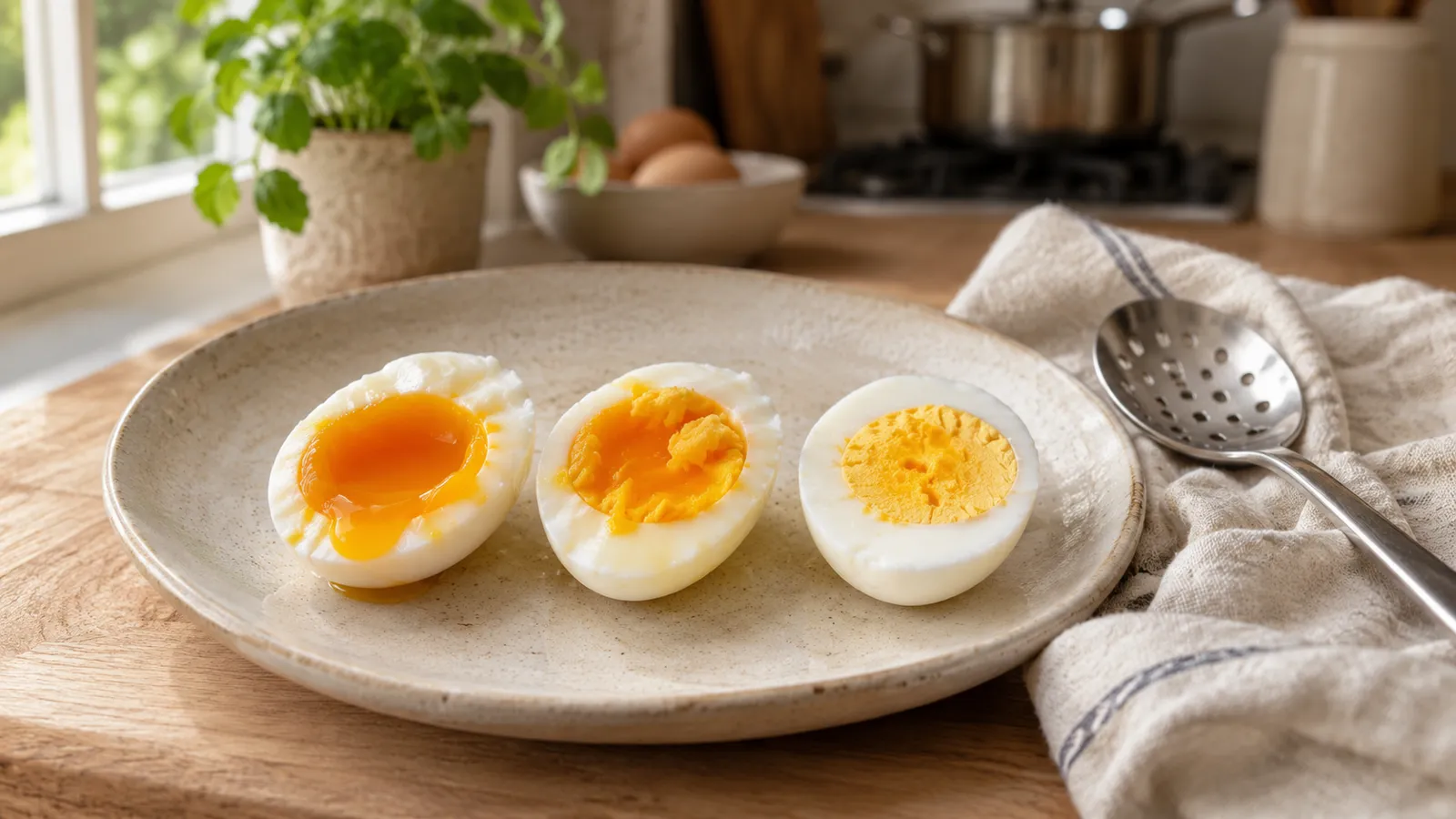
How long to boil an egg for each yolk
Lower refrigerated large eggs into water that is already boiling, press Start as they go in, and keep a gentle simmer. Use 6 minutes for soft, 7 for jammy, 9 for medium and 12 for hard. If you want the full comparison of boiling methods, the guide to how long to boil eggs covers them one by one; this page is the timer that runs the number for you.
Only the 12-minute hard egg has a published figure behind it: the American Egg Board gives 12 minutes for large and 13 for extra-large, based on eggs straight from the refrigerator, cooked covered over only ½ to 1 inch of boiling water, with or without a steamer insert. Using that 12 minutes for eggs lowered into a simmering pot is this site's choice, not the Egg Board's, so I'd treat your first batch as the check. The 6, 7 and 9 are this site's estimates for softer yolks. I'd rather say that outright than dress up a kitchen convention as a standard, because the honest reading is that those three numbers are a place to start.
How long for a soft-boiled egg with a runny yolk?
Start at 6 minutes for a large fridge-cold egg. A runny yolk leaves very little margin, so I'd cook it for someone who wants it that way, and I'd keep it off the plate of anyone at higher risk. FDA advises cooking eggs until both the white and yolk are firm, and it names children, older adults, pregnant women and people with weakened immune systems as being at greater risk. Pasteurized shell eggs are the way to serve an undercooked yolk with less risk.
How long for a jammy ramen egg?
Start at 7 minutes, then move the egg straight to ice water when the alarm goes. The ice bath matters more at this setting than at any other: a jammy yolk sits between runny and set, so a few minutes of residual heat can carry it past what you were after. That's why the timer offers an ice-bath countdown as soon as the boil ends.
Should you start eggs in hot or cold water?
For a countdown, I prefer the boiling-water start, because the moment the clock begins is unmistakable. Cold-water methods depend on how long your burner takes to reach a boil, so a time means less. The trade-off is that you have to lower eggs into hot water carefully.
If you want to hard-cook a batch without hovering, choose the cold-water method in the timer. It uses the USDA procedure: eggs in a single layer, cold water at least an inch above them, covered, brought just to a boil, then the heat turned off. Eggs stand 12 minutes for medium, 15 for large and 18 for extra-large. Those times belong to that procedure only. Carrying 15 minutes over to a pot of boiling water would overcook the egg, which is why the two methods stay separate here.
How long to boil eggs at high altitude
Water boils cooler as you climb. Colorado State University Extension lists about 208°F at 2,000 feet, 203°F at 5,000, 198°F at 7,500 and 193°F at 10,000, against 212°F at sea level, and it says boiled and simmered foods need longer as a result. Enter your altitude and the timer warns you from 2,000 feet up.
The timer does not add minutes to the boiling-water time, and that is deliberate. Colorado State says hard-cooked eggs take longer and gives one example: a “3-minute” egg may take 5 minutes at 5,000 feet. That's the only published figure I found for a boiled egg, and it describes a very short cook, so it gives no scale for a 12-minute one. Calculators that stretch a number like that disagree by several minutes on the same egg. A correction with no method behind it would look precise and could still leave you with an undercooked yolk, so I'd rather warn you and have you check. Above 5,000 feet, the one complete method I could find is the cold-water one from Colorado State: bring the pan to a boil, simmer 5 minutes, then let the eggs stand covered for 15 minutes (large) or 20 (extra-large). Pick the cold-water method and the timer runs that sequence, stage by stage. The university itself says cooks will need to test it, so cut one egg open before you trust the batch.
How egg size and temperature change the time
The timer starts from a large refrigerated egg and applies one formula, shown here so you can check it:
- Size: time × (1 + steps ÷ 12), where steps run small −2, medium −1, large 0, extra-large +1 and jumbo +2. A 12-minute hard egg becomes 13 minutes at extra-large, which is the American Egg Board's own step. Extending it to small and jumbo is this site's estimate.
- Room-temperature egg: 15% off soft and jammy times, 10% off medium and hard. I found no authority for this, so treat it as my estimate. I kept the cut small on purpose, because undercooking is the more serious mistake.
The size choices follow USDA minimum weights per dozen: 18 ounces for small, 21 medium, 24 large, 27 extra-large and 30 jumbo. Don't leave eggs out just to match a setting. Fridge-cold is the easiest starting point to repeat, and that's the one I'd use.
Why are my boiled eggs hard to peel?
Usually because they're very fresh. USDA says extremely fresh eggs are difficult to peel and suggests eggs that have been refrigerated for several weeks, and Colorado State suggests eggs 7 to 10 days old. Polly Burey, a food science professor at the University of Southern Queensland, explains that the white's pH rises as an egg ages, with research pointing to about 8.7 to 8.9 for easy peeling, and that the air cell grows too. A hot-water start may help the membrane separate, and ice water afterward may help the white pull away from the shell.
What I'd do: buy the eggs you plan to boil a week or so ahead, use the hot-water start, and take the ice bath seriously. USDA's own trick is to tap the shell gently all over and peel under running water.
What happens if you lock your phone?
The timer stores its end time, so a reload resumes the countdown, though your browser needs one tap on the page before the alarm sound can play again. With Keep screen on ticked, it asks the browser to hold the display awake, where the browser allows it, and the page title shows the time left. The alarm repeats until you stop it, and it can also send a notification if you allow one. A phone that fully suspends the browser can still delay all of this, so if you plan to leave the kitchen, I'd set a device alarm as well.
Cooling and storing boiled eggs
Set out the ice before the alarm goes. The five-minute ice-bath countdown is my own default, not an official figure; the point is to stop the cooking quickly. Then refrigerate. FDA says to use hard-cooked eggs, in the shell or peeled, within one week, and never to leave cooked eggs out for more than 2 hours, or 1 hour above 90°F. The American Egg Board's recipe is stricter once peeled, at two days, so if you peel ahead I'd follow that shorter number. For carton and storage questions see how long eggs last, and if you're out of eggs for a recipe, the egg substitute guide is the next stop.
Pause stops the display and nothing else: an egg left in hot water keeps cooking. That's the one behavior I'd want every cook to know before pressing it.
FAQ
How long do you boil an egg for a runny yolk?
Start at 6 minutes for a large refrigerated egg lowered into boiling water, or about 6½ for extra-large. That is this site’s estimate. FDA advises cooking eggs until both white and yolk are firm, and using pasteurized eggs for anything served undercooked.
How long for a jammy ramen egg?
Start at 7 minutes for a large refrigerated egg, then move it straight to ice water so the yolk stops cooking. That timing is this site’s estimate, and the ice bath does a lot of the work at this setting.
Should eggs go in hot or cold water?
Either works, but the times are different. This timer’s main setting is for a boiling-water start, where the moment the clock begins is easy to pin down. The cold-water option uses USDA’s covered-stand times of 12, 15 and 18 minutes for medium, large and extra-large eggs.
Do I need more time at high altitude?
Yes. Colorado State University says hard-cooked eggs take longer and gives one example: a “3-minute” egg may take 5 minutes at 5,000 feet. That doesn’t scale to a 12-minute egg, so this timer warns you instead of adding minutes. Water boils at about 203°F at 5,000 feet. Above that height, the cold-water option uses the university’s published method. Cut an egg open to check.
Why are my boiled eggs hard to peel?
Usually because they are very fresh. USDA advises hard-cooking eggs that have been refrigerated for several weeks, and Colorado State suggests eggs 7 to 10 days old. A hot start and an ice bath may help too. Tap the shell all over and peel under running water.
How long do hard-boiled eggs last in the fridge?
FDA says to use hard-cooked eggs, in the shell or peeled, within one week, and not to leave them out for more than 2 hours, or 1 hour above 90°F. The American Egg Board’s recipe says two days once peeled, which is the number I’d follow for peeled eggs.
Will the alarm work with my phone locked?
It may not. The timer asks the browser to keep the screen on and resumes after a reload, but a phone that suspends the browser can delay the alarm. If you are leaving the kitchen, set a device alarm as a backup.
Does Pause stop the eggs cooking?
No. Pause only stops this countdown. Eggs keep cooking in hot water, and resuming the timer does not undo that heat.
Sources
- FDA — What You Need to Know About Egg Safety
- American Egg Board — Easy-Peel Hard-Boiled Eggs
- USDA FSIS — How long does it take to hard cook an egg?
- Colorado State University Extension — High Elevation Hard-Cooked Eggs
- Colorado State University Extension — High Altitude Food Preparation (boiling points)
- Eggland's Best — USDA chart of minimum net weight per dozen
- Polly Burey, University of Southern Queensland — Why some eggs peel badly