Cups to Grams Converter for Baking
Convert cups to grams, or grams to cups
1 US cup of all-purpose flour weighs about 120 g, granulated sugar 198 g, packed brown sugar 213 g, and butter 227 g; a cup of water is about 237 g. Each ingredient has its own weight per cup, and published figures differ (flour runs 120 to 142 g depending on how the cup is filled), so choose the ingredient first and check the source beside the result.
| Source and method | 1 cup | ½ cup | ⅓ cup | ¼ cup |
|---|---|---|---|---|
| King Arthur Baking (spoon in, sweep level) | 120 g | 60 g | 40 g | 30 g |
| USDA FoodData Central (no method stated) | 125 g | 63 g | 42 g | 31 g |
| America's Test Kitchen (dip and sweep) | 142 g (5 oz) | 71 g | 47 g | 35 g |
How many grams in 1 cup of flour?
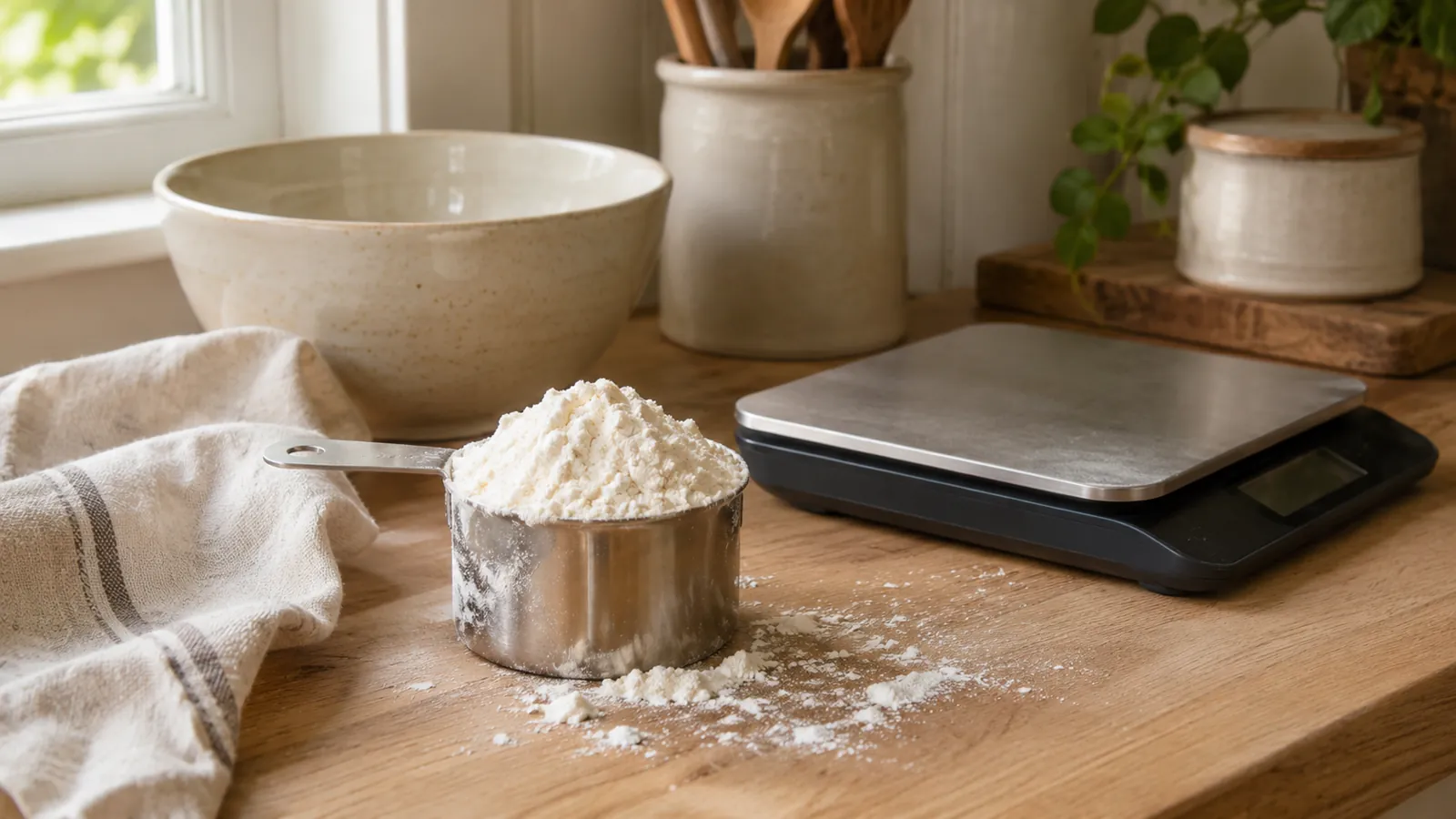
The short answer is 120 grams, and that's the number I'd use for a recipe written with a spooned cup. But a cup of flour is the one conversion where the honest answer comes with a range. King Arthur's ingredient weight chart lists 120 g and doesn't say how the cup was filled; its recipe success guide does: spoon dry ingredients gently into the cup and sweep off the excess. USDA's data lists 125 g without naming a method. America's Test Kitchen prefers dip and sweep and says it reliably yields a 5-ounce cup, which is about 142 g.
That is an 18 percent spread between the lowest and highest figure, and none of the three is wrong. They describe different ways of filling the same cup. That's why the converter above shows all three beside the result and lets you switch between spooning and dipping. My own rule is simple: use the method the recipe's author used. If the recipe doesn't say, I'd go with 120 g, because a slightly light cup is easier to correct than a heavy one that has already dried out the dough.
Common baking ingredients: 1 US cup in grams
| Ingredient | 1 cup | ½ cup | 1 tablespoon |
|---|---|---|---|
| All-purpose flour | 120 g | 60 g | 7.5 g |
| Bread flour | 120 g | 60 g | 7.5 g |
| Whole wheat flour | 113 g | 57 g | 7 g |
| Granulated sugar | 198 g | 99 g | 12.4 g |
| Brown sugar, packed | 213 g | 107 g | 13.3 g |
| Confectioners' sugar | 113 g | 57 g | 7 g |
| Butter | 227 g | 113 g (1 stick) | 14 g |
| Cocoa powder | 84 g | 42 g | 5.3 g |
| Water | 237 g | 118 g | 15 g |
| Milk (USDA lists 244 g) | 227 g | 113 g | 14 g |
| Heavy cream (USDA lists 238 g) | 227 g | 113 g | 14 g |
| Vegetable oil (USDA lists 218 g for canola) | 198 g | 99 g | 12.4 g |
| Honey | 336 g | 168 g | 21 g |
| Chocolate chips | 170 g | 85 g | — |
Why there is no single "cups to grams" number
Ask what a cup weighs and the only honest answer is "a cup of what?" A cup measures volume; a scale measures weight. The same cup holds 120 grams of all-purpose flour and 198 grams of granulated sugar, because each ingredient packs into the space differently. A converter that turns "1 cup" into one fixed number of grams is quietly assuming water, which is fine if you're baking water. So this converter asks for the ingredient first.
I rely on the King Arthur Baking ingredient weight chart here because it's detailed, publicly available and tied to how their recipes are written. I wouldn't treat any one chart as law, and where a recognized source disagrees by a meaningful amount, the result tells you so. If a recipe states its own weight per cup, follow the recipe: its author worked with that number, and I'd take that over any chart, this one included.
Grams to cups: going the other way
The same converter runs backward. Choose grams, ounces or pounds as the unit, or press the swap button after a conversion, and it returns cups along with a measuring plan. Grams to cups rarely lands on a tidy fraction, so I only show one like 2⅛ when it's within 1 percent of the true amount. Otherwise you get "about 2 cups" plus the exact scoops: 250 grams of all-purpose flour on the King Arthur figure is 2 cups, 1 tablespoon and 1 teaspoon.
Going this direction, I'd pay attention to the "by source" line. The same 250 grams is about 2 cups by USDA's weight and only about 1¾ cups by the dip-and-sweep figure. If you're converting a European recipe and you measure by dipping, you'll want that lower number or your dough will end up heavy with flour. Better still, weigh the flour and skip the question.
How the flour was measured matters more than the converter
Spooning and dipping can differ by more than 20 grams per cup, which is enough to turn a soft cookie into a dry one. It's the main reason I'd weigh flour whenever a scale is available. Dip the cup into the bag and you compress the flour, so the cup holds noticeably more than a gentle spoonful does.
If cups are all you've got, measure the same way every time. Converting your own family recipe to grams? Weigh a cup measured your usual way, once, and use that number for that recipe. In that one case I'd pick your number over every chart, since it reflects how the recipe has always been made in your kitchen.
Worked example: a cookie recipe
A recipe calls for 2¼ cups all-purpose flour, 1 cup packed brown sugar, ½ cup granulated sugar and 1 cup butter. Converted with the chart, that becomes 270 grams of flour, 213 grams of brown sugar, 99 grams of granulated sugar and 227 grams of butter, which is two US sticks.
Once it's written in grams, the recipe gets easier to scale, and I think that's the best argument for doing this at all. Doubling 270 grams of flour beats doubling 2¼ cups and trying to remember how many quarter cups that makes with butter on your hands. If you're changing the batch size, let the recipe scaler multiply the list and convert it to grams in the same step.
Which ingredients are worth weighing
You can get away with weighing only a few things, and I'd start with flour, then sugar and cocoa. These dry ingredients change the most with scooping habits, and they control structure, spread and sweetness. Butter is already predictable in sticks. Mix-ins such as chocolate chips and nuts are forgiving: ten grams more or less changes the cookie a little and leaves the recipe intact. That order gets you most of the benefit of a scale without turning a batch of cookies into a lab report.
How many grams in a cup of butter, water or milk?
In the United States, butter is sold in sticks of half a cup, eight tablespoons or about 113 grams, so a cup of butter is two sticks, about 227 grams. The wrapper markings are a practical guide for cutting tablespoons, and I think of butter as the one ingredient where the packaging already did the math. Outside the US, butter is sold in blocks of different sizes, so a recipe that says "1 stick" needs the gram conversion. I'd skip any guess based on the local block.
Water is the easy one: a US cup holds 236.6 milliliters and a milliliter of water weighs about a gram, so a cup weighs about 237 grams, which is also what USDA lists for 8 fluid ounces. King Arthur's chart writes water, milk and cream as 8 ounces (227 g), which reads to me as a round recipe convention rather than a measured weight. For water I use the physical number everywhere on this site. For milk, USDA lists 244 grams for a cup of whole milk and King Arthur 227, a 7 percent gap, and oil shows the same pattern at 218 against 198. The converter defaults to King Arthur, since its weights are the ones its recipes were written around, and shows the USDA figure next to it. If a recipe was developed by weight, follow its number, and if you're pouring milk into a pancake batter, use whichever tool is in your hand.
Sticky and heavy ingredients
Honey, molasses and maple syrup are heavy for their volume: a cup of honey weighs far more than a cup of water. They also cling to the measuring cup, so a volume measurement often delivers less than the recipe intended. I'd leave the cup in the drawer and weigh them straight into the bowl on a tared scale, which avoids both problems and gives you one less sticky thing to wash.
US cups, metric cups and legal cups
Every number on this page uses the US customary cup of 236.6 milliliters. Australia, Canada, New Zealand and some other Commonwealth countries use a metric cup of 250 milliliters, about 6 percent larger, and US nutrition labels use a legal cup of 240 milliliters. A recipe from Melbourne or Toronto may therefore mean a slightly bigger cup than the one in an American kitchen, and I'd measure a little generously if the recipe was written for one.
Limits of this converter
The converter covers common baking ingredients in their usual forms. Sifted flour, which weighs less per cup, falls outside it, along with chopped versus whole ingredients beyond those listed. Tablespoon and teaspoon results are calculated from the cup weight, so for very small amounts of leaveners or salt, I'd follow the recipe's own measurement instead. And if the tool tells you a result looks like 113 cups, believe it: that's the warning for a typo, and a real recipe rarely asks for that much of anything.
FAQ
How many grams is 1 cup of flour?
About 120 grams of all-purpose or bread flour on the King Arthur Baking chart, 125 grams in USDA's data, and about 142 grams if you dip the cup and sweep it level, the America's Test Kitchen method. Whole wheat flour is about 113 grams on the King Arthur chart.
How many grams is ½, ⅓ or ¼ cup of flour?
On the King Arthur figure of 120 grams per cup, ½ cup is 60 grams, ⅓ cup is 40 grams and ¼ cup is 30 grams. On USDA's 125 grams, they are 63, 42 and 31 grams.
How many grams is 1 cup of sugar?
About 198 grams of granulated sugar, 213 grams of packed brown sugar and 113 grams of unsifted confectioners' sugar.
How many grams is 1 cup of water or milk?
A US cup of water weighs about 237 grams. Milk is listed at 227 grams by King Arthur Baking and 244 grams for whole milk by USDA; King Arthur's figure is a round 8 ounces, so when a recipe gives its own weight, use it.
Why is flour 120 g on some charts and 125 g on others?
Publishers fill the cup differently and round differently. King Arthur tells you to spoon the flour in and sweep it level, USDA lists 125 grams without naming a method, and dipping the cup into the bag packs it to about 142 grams, according to America's Test Kitchen.
Is a US cup the same as a metric cup?
No. A US cup is 236.6 milliliters. The metric cup used in Australia, Canada and New Zealand is 250 milliliters, about 6 percent larger.
How do I convert grams to cups?
Choose grams as the unit, or press the swap button after a conversion. Divide the grams by the weight of one cup of that ingredient: 250 grams of all-purpose flour divided by 120 is about 2 cups, or exactly 2 cups, 1 tablespoon and 1 teaspoon.
How many grams is a cup or a stick of butter?
A US stick of butter is half a cup or eight tablespoons, about 113 grams. Two sticks make one cup, about 227 grams.
Sources
- King Arthur Baking — Ingredient Weight Chart
- King Arthur Baking — Recipe success guide
- Iowa State Extension — Meet the wheat flours
- America's Test Kitchen — Measuring ingredients
- USDA FoodData Central — All-purpose flour (SR Legacy)
- USDA FoodData Central — Whole milk (SR Legacy)
- USDA FoodData Central — Heavy whipping cream (SR Legacy)
- USDA FoodData Central — Canola oil (SR Legacy)
- USDA FoodData Central — Tap water (SR Legacy)
- Wikipedia — Cup (unit)