Steak Temperature Chart: Doneness and Safety
For whole beef steaks, the USDA consumer recommendation is 145°F (63°C) plus a 3-minute rest. Culinary labels such as rare and medium-rare often describe lower temperatures; those labels are not safety standards.
| Decision | Temperature or instruction | Meaning |
|---|---|---|
| Whole beef steak minimum | 145°F / 63°C plus 3-minute rest | US consumer safety recommendation |
| Medium-rare, Illinois Extension label | 145°F / 63°C | Follow with a 3-minute rest; other charts may use lower temperatures |
| Medium, Illinois Extension label | 160°F / 71°C | Culinary reference above the whole-steak minimum |
| Well-done, Illinois Extension label | 170°F / 77°C | Culinary reference above the whole-steak minimum |
| Ground beef patty | 160°F / 71°C | Different product category |
Agree on a temperature before a doneness label
Ask around for medium-rare and you'll collect a spread of opinions, which is why I'd talk about the measured endpoint before words such as rare or medium-rare. Those labels can hide different expectations. The consumer safety recommendation belongs right alongside the chart, so a restaurant-style description can't pass for the official minimum.
Start with the distinction that charts often hide
A doneness chart describes a culinary preference. A safe-minimum chart gives a public-health recommendation. Put them in one table without explanation and a rare-steak temperature starts to look like an equally protective alternative to the official minimum, which it isn't.
The culinary labels in this table follow Illinois Extension: 145°F for medium-rare, 160°F for medium, and 170°F for well-done. Other charts assign different temperatures, especially to rare and medium-rare, so I'd read the number and treat the label with some suspicion. The separate USDA minimum remains 145°F before removal from heat, followed by a three-minute rest.
Use a thermometer instead of the finger test
The finger test has charm, and I still wouldn't trust it with dinner. Touch can suggest how firm a steak feels, but it measures nothing about the internal temperature. Thickness, cut, and the person doing the comparison all affect the impression, and even the most confident touch test can't supply a number.
Insert a suitable food thermometer into the thickest part. For a thinner steak, enter from the side so the sensing area reaches the center. Avoid bone and the hot pan, and let the reading settle before deciding whether to continue cooking.
Check more than one place when the shape varies
A thick edge and a thin tail can cook differently, and a bone-in steak has areas that may heat differently too. Check the thickest area and another relevant location instead of whichever exposed edge happens to be most convenient.
When cooking several steaks, evaluate them individually. Equal time on the same grill guarantees nothing about equal internal temperatures, which is bad news for anyone hoping to flip a whole party's dinner on one timer. Keep a clean plate available for finished steaks and use separate or cleaned utensils after contact with raw meat.
Do not subtract a fixed carryover allowance
Some recipes discuss temperature rise after removal from heat. The amount depends on the steak and the cooking method, and there's no universal five- or ten-degree increase that can safely be assumed for every piece.
For the straightforward guidance here, reach 145°F before removal and then rest for three minutes. Pork chops and roasts use the same 145°F rule with a rest; see the pork temperature guide. If you are evaluating a different method, keep its complete assumptions together. I'd steer clear of borrowing a lower removal temperature without the rest of the protocol, because a method's parts were only ever described as a set.
Ground beef needs a different line on the chart
A burger is not simply a small steak. The cited consumer guidance gives ground beef a 160°F minimum. Use the product category to choose the target, and follow specific instructions for prepared or mechanically tenderized products.
A browned burger can still have an inadequately heated center, so the same principle applies: measure, and ignore the surface color. However you like your steak, that preference stays with the steak. Do not carry it into a ground-meat safety decision.
A browned crust and a lower center reading
Suppose the outside looks exactly as you want but the center measures below 145°F. The crust is telling you about the surface, and the consumer recommendation for the center and three-minute rest hasn't moved. Continue with a suitable cooking method and check again. Between a crust that's a shade past perfect and a center short of the number, I'd accept the crust every time.
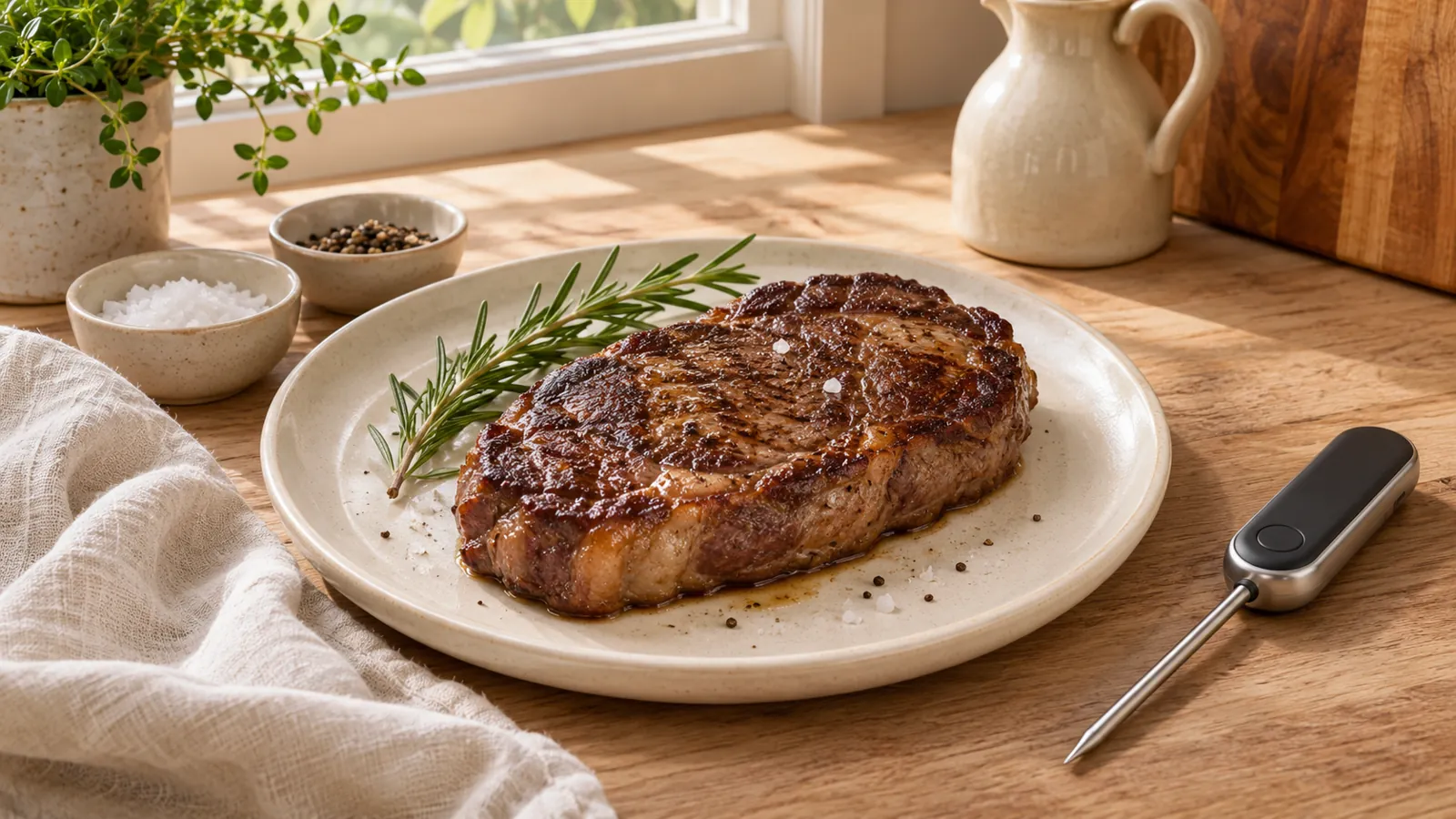
If the steak is uneven, take more than one meaningful reading, and resist the conveniently thin edge that would spare you from measuring the thicker center. For your next attempt, I think the useful notes are thickness and the actual endpoint, along with the texture you liked. That information is reproducible, while a photograph labeled medium is no calibrated temperature reference. The image on this page illustrates a steak and is not evidence from a tasting or doneness experiment.
FAQ
Is medium-rare steak at the USDA recommended minimum?
Culinary medium-rare recommendations often fall below 145°F. The USDA consumer recommendation for whole beef steaks is 145°F followed by a three-minute rest. A doneness label does not establish that the safety recommendation has been met.
Can I judge steak by its color?
Color is not a reliable substitute for a correctly placed thermometer. Lighting, meat characteristics, and cooking conditions affect appearance. Check the thickest part and follow the relevant temperature and rest guidance instead of using a photograph as a safety test.
Why is there no single exact temperature for every label?
Doneness labels are culinary conventions and can vary among recipes and restaurants. A precise-looking table can hide that variation. This guide emphasizes the measured temperature and official minimum so the label does not become a misleading safety claim.
Does resting let me remove the steak below 145°F?
The guidance here is to reach 145°F before removal, then rest for three minutes. It does not assume a fixed temperature rise after removal. Carryover depends on the steak and method, so an unmeasured prediction is not equivalent to confirmation.
Can I use the steak target for hamburgers?
No. Ground beef uses a 160°F minimum in the consumer chart. Choose the target by product type, not by the animal alone. Check the center of the patty with a thermometer rather than relying on browning or juices.