Prime Rib Temperature: Safe Minimum and Probe Placement
The USDA household minimum for a beef rib roast is 145°F (63°C), followed by at least 3 minutes of rest. Rare and medium-rare restaurant targets are lower than that recommendation; they are not equivalent safety endpoints.
| Decision | Reference | Meaning |
|---|---|---|
| Household safe minimum | 145°F (63°C) + 3-minute rest | USDA recommendation for beef roasts |
| Rare or medium-rare targets | Below 145°F | Below this safety recommendation |
| Bone-in rib roast, 4–6 lb | 23–25 min/lb at 325°F | Planning estimate; measure the center |
Separate the serving preference from the safety rule
Prime rib arguments tend to run two questions together: what shade people like in the middle, and what temperature public-health guidance recommends. I'd answer the safety question first, because this is a general household guide and that answer is short: 145°F (63°C), then at least 3 minutes of rest. A preference for a rosy slice leaves the official number exactly where it was.
If you see a lower target in a restaurant-style method, recognize that it falls below the recommendation here. This guide offers no validated lower-temperature holding process, and I'm not about to improvise one around a holiday table. A big price tag, high quality, or the word prime on the label establishes no different household safety rule.
Find the center of the meat
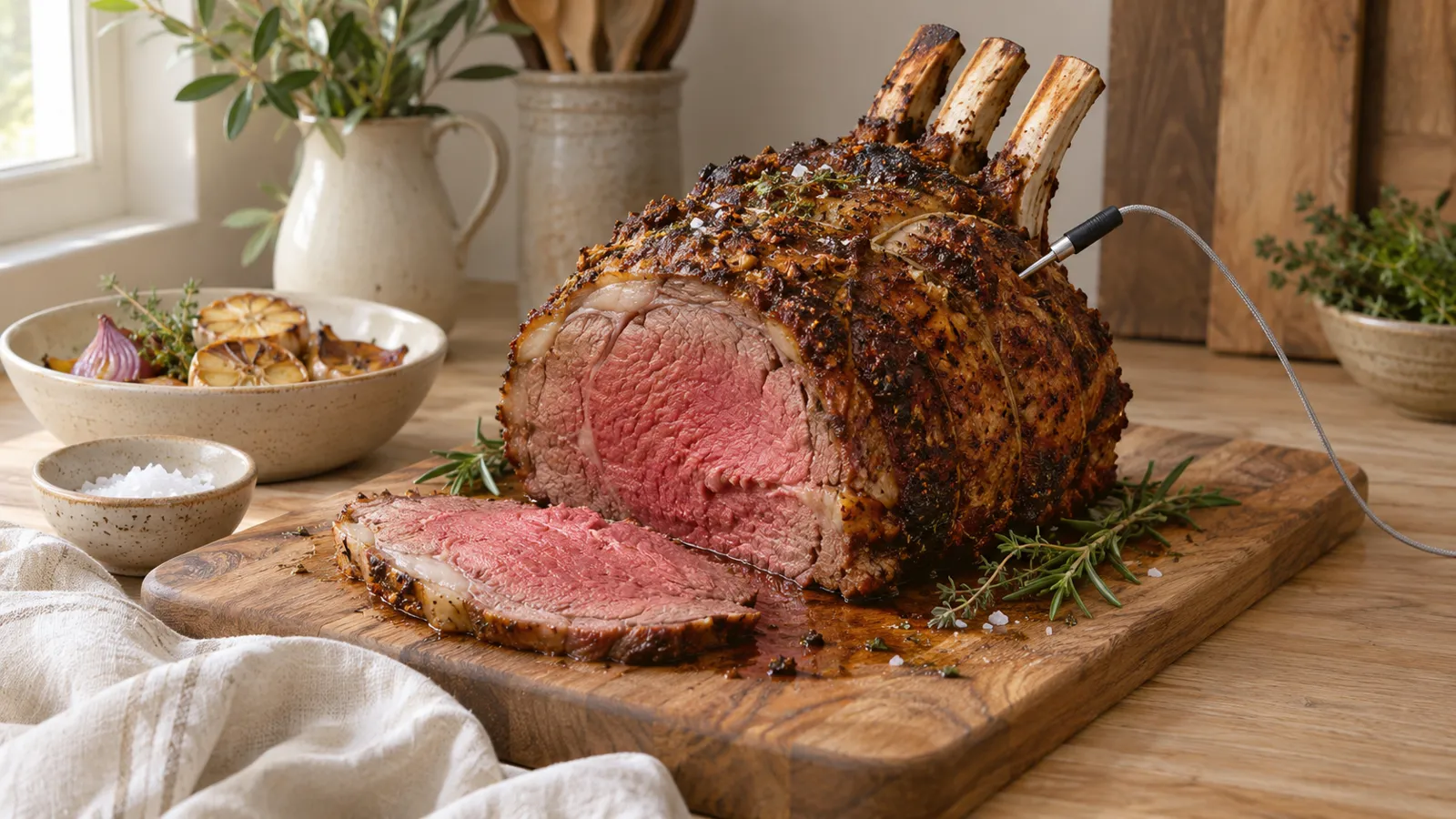
Place the thermometer's sensing area in the thickest central muscle, avoiding bone and large pockets of fat. A rib bone makes a handy visual landmark, as long as it never becomes the surface your probe rests against. Take readings in more than one place when the roast is uneven.
A leave-in probe helps you watch the approach to the endpoint. I'd still confirm with a second placement before serving, because a perfectly functioning thermometer can sit in an unrepresentative location and report on it faithfully. Knowing what the device measures is as important as watching its display.
What the roasting estimate actually tells you
FoodSafety.gov lists approximately twenty-three to twenty-five minutes per pound at 325°F (163°C) for a four- to six-pound bone-in rib roast. For a five-pound roast, that suggests roughly one hundred fifteen to one hundred twenty-five minutes. I'd use that figure to decide when the oven goes on and when the side dishes start, and for nothing beyond that: it's a planning calculation, not evidence that a particular roast is done.
The roasting chart doesn't validate every high-heat start, closed-oven method, or unusually large roast. If you change the method, use instructions developed for that method. I think of a recipe as a package deal here, because the oven setting from one approach paired with the timing from another describes a roast nobody has written instructions for.
Carryover is variable
The center can continue warming after removal, but the amount is no guaranteed number of degrees. Roast size, temperature differences within the meat, and resting conditions all matter, so I'd hand carryover no important jobs. Follow the safe minimum guidance and reach the target before removal. Carryover has no business making an under-temperature roast safe.
For a broader explanation of culinary doneness terms, see the steak temperature chart. For food saved after carving, use the leftover guide. I'd carve only what's needed at first and arrange prompt storage for the remaining portions, since a half-carved roast on the table has a way of being forgotten once dessert arrives.
FAQ
Is 130°F prime rib USDA-safe under this guidance?
No. That is below the household minimum used here for beef roasts. It may appear as a culinary doneness preference elsewhere, but it should not be labeled equivalent to 145°F with a three-minute rest. The preference and the public-health recommendation need to remain visibly separate.
Does bone-in prime rib need a different final temperature?
No, the stated minimum for the beef roast remains the same. Bone affects shape and can complicate thermometer placement, so measure the meat away from it. The timing estimate in this guide specifically describes a bone-in rib roast within the stated weight range.
Can I cook by minutes per pound alone?
Use that calculation to organize the meal, not to decide when the meat is ready. Two roasts of similar weight can have different thicknesses and starting conditions. A thermometer check in the central meat gives you information the scale and kitchen timer cannot supply.
Should I remove it early for carryover cooking?
This guide recommends reaching the safe minimum before removing the roast, then allowing the required rest. Carryover is too variable to treat as a guaranteed correction. If a different method relies on controlled lower-temperature cooking, it needs its own validated conditions rather than an improvised counter rest.
Why are the end slices more done?
The ends are more exposed to heat than the central portion, so a roast can have a range of textures. That is one reason to check the thickest central meat. You can distribute slices according to preferences, but the least-cooked central area still needs the applicable safety check.