Cornstarch Substitute: Choose by Sauce, Pie, or Coating
For ordinary sauce thickening, use about 2 tablespoons all-purpose flour for 1 tablespoon cornstarch. Expect a more opaque result. Pies, gluten-free baking, coatings, and canning need their own guidance.
| Use | Practical choice | What changes |
|---|---|---|
| Everyday sauce or gravy | About 2 tablespoons all-purpose flour per tablespoon cornstarch | More opaque appearance; needs thorough cooking |
| Glossy fruit filling | A recipe-specific starch alternative | Ratio depends on fruit and thickener |
| Gluten-free preparation | A suitable labeled gluten-free starch | Wheat flour is not suitable |
| Canning | Only the thickener in a tested canning recipe | Do not improvise from a sauce substitution chart |
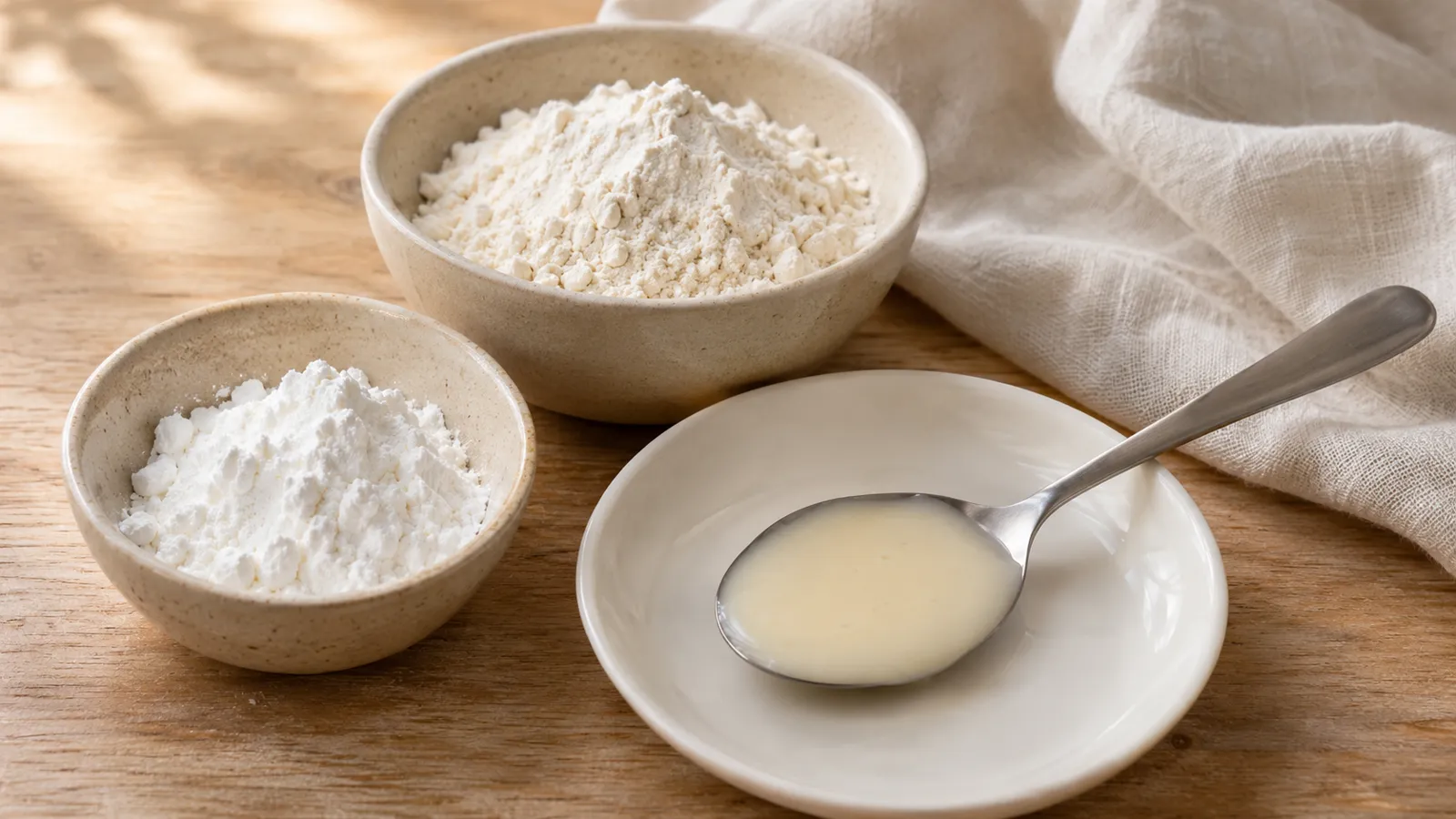
Gravy and glossy fillings need different substitutes
For an ordinary gravy with an opaque finish, flour is my preferred fallback. A translucent glaze or a pie that needs to slice cleanly deserves a recipe-specific alternative. Hot-pan thickness is only one consideration: appearance and cooled texture also determine whether the swap works for the dish.
For ordinary sauce thickening, all-purpose wheat flour has roughly half the thickening power of cornstarch, which is why a two-to-one amount is a common starting substitution. It is useful when the cupboard is bare, but the sauce will not necessarily have the same appearance or mouthfeel.
First identify the job. Cornstarch in a gravy is not doing exactly the same work as cornstarch in a cookie, a fried coating, or a fruit pie. A single universal ratio would hide those differences. The most helpful replacement is the one that suits the dish you are actually making.
Worked example: replacing a tablespoon
If a sauce calls for one tablespoon of cornstarch, two tablespoons of all-purpose flour is a practical starting amount. That is a volume substitution for thickening, not a claim that the two powders weigh the same. Measure them separately and avoid heaped spoons.
Disperse the flour using a method appropriate to the sauce, such as a properly prepared roux or a smooth mixture with cool liquid before adding it. Sprinkling dry flour straight into hot liquid is an easy way to create lumps. Follow the dish's cooking method so the flour cooks through rather than leaving a raw taste.
Add and assess carefully. A sauce's final consistency depends on its liquid, temperature, and the rest of the ingredients. If you are reducing the liquid at the same time as adding a thickener, both changes can make it seem to thicken quickly.
Choose appearance as well as thickness
Flour can be perfectly acceptable in an opaque gravy where clarity is not the goal. In a translucent fruit sauce, the visual difference may be much more noticeable. Decide whether that matters before changing the thickener.
A thick sauce is not automatically a good sauce. It may coat a spoon but feel heavy, or look glossy while still running off the food. Think about the serving task: a sauce to drizzle, a filling to slice, and a glaze to cling to a surface need different behavior.
Use the same serving temperature when judging a substitution. Comparing one sauce hot from the pan with another after it has cooled gives an unfair impression of their thickness. A small sample on a cool plate can help you see what the sauce will be like at serving temperature.
Why fruit pies need their own instructions
The amount of thickener in a fruit pie depends on the fruit, its juice, and the formula. King Arthur's pie guidance lists alternatives with quantities matched to particular fillings. Use that kind of recipe-specific direction rather than importing a gravy conversion into a pie.
Tapioca also comes in forms that do not behave identically during preparation. A recipe using quick-cooking tapioca may require a rest before baking. Do not silently replace a granulated product with a different starch and assume the process stays unchanged.
Give the finished pie the cooling time its recipe requires before judging the filling. Cutting immediately and deciding that the starch failed can confuse a cooling problem with an ingredient problem. Record the substitution and the cooling time together if you are comparing batches.
Arrowroot, potato starch, and tapioca: read the product
Alternative starches are useful, but their cooking behavior and recommended amounts differ. Follow product or recipe instructions for the specific starch. A package of potato flour is not the same thing as potato starch; similar names do not make them interchangeable.
When replacing cornstarch because of a dietary requirement, check more than the ingredient's name. Read the label for relevant allergens and handling information. All-purpose wheat flour is unsuitable when the dish must be gluten-free, even if it would thicken the sauce successfully.
For a new starch, start with a small portion of the sauce if the dish allows it. That limits the amount committed to an unfamiliar texture. Keep the rest of the sauce unchanged so you can compare the result before thickening the entire pan.
Three situations where a quick swap is a poor fit
Home canning: thickener choices can affect a tested process. Use an authoritative canning recipe with its specified ingredients. A successful dinner sauce does not establish the safety of a shelf-stable jar.
Precision baking: cornstarch can affect structure in a dry mixture, so a sauce-thickening ratio is not automatically appropriate. Use the recipe author's alternative or choose a formula built for the ingredients you have. If the bake is also missing a leavener, the baking powder substitute and baking soda substitute guides cover those separately.
A crisp coating: flour and starch combinations affect the coating as well as its thickness. Decide whether a different crust is acceptable, and do not promise that a two-to-one gravy conversion will reproduce the original crunch.
Replacing two tablespoons without creating lumps
At the sauce-thickening ratio in this guide, two tablespoons cornstarch correspond to about four tablespoons all-purpose flour. That is a quarter cup of flour. It is a noticeably larger dry addition, so the flour must be incorporated using a suitable sauce method rather than dumped into a finished hot sauce.
For this two-tablespoon substitution, write down the four-tablespoon flour amount before starting the sauce. Then follow the chosen flour-based method through its cooking stage before assessing thickness. If the sauce is opaque but coats the food well, that is the expected tradeoff—not a reason to keep adding flour in pursuit of cornstarch’s appearance.
FAQ
Can I use flour instead of cornstarch in gravy?
Yes, all-purpose flour is a practical fallback for ordinary gravy. Start with roughly twice the cornstarch volume, disperse it using the sauce’s method, and cook it thoroughly. Expect a less translucent result. The ratio is for thickening, not a universal substitution in every baked or fried food.
Is potato flour the same as potato starch?
No. Similar names do not make the products interchangeable. Read the package and use instructions for the actual ingredient you have. A recommendation for potato starch should not be applied automatically to potato flour, especially in a formula where thickening and texture matter.
Can I use the sauce ratio in a fruit pie?
Do not assume it will work unchanged. Fruit type, juice, and the thickener all affect the needed amount. Use a pie-specific substitution chart or the recipe author’s alternative, and allow the required cooling time before judging the filling. A gravy ratio leaves too many variables unresolved.
Is flour a gluten-free alternative?
Ordinary all-purpose wheat flour is not gluten-free. Choose a suitable starch and check its labeling for the requirements of the person eating the dish. A successful thickening result does not establish dietary suitability, and different products can have different handling or allergen information.
Can I change thickeners in home-canned filling?
Use the ingredients specified by an authoritative tested canning recipe. A substitution suitable for a sauce eaten immediately does not establish a safe canning process. Do not carry a general thickener ratio into a shelf-stable preparation without process-specific guidance.