Cream of Tartar Substitute: Match the Job First
For whipped egg whites, lemon juice or white vinegar can sometimes replace cream of tartar in small measured amounts. For leavening or candy, use a recipe-specific alternative; there is no universal swap for every job.
| Where it appears | Possible approach | What not to assume |
|---|---|---|
| Whipped egg whites | A small amount of lemon juice or white vinegar, following a specific method | Baking powder is not an equivalent stabilizer |
| Paired with baking soda | A complete leavener substitution from the recipe author | Replacing only the acid leaves the formula changed |
| Sugar work or candy | Use the formula's tested alternative | A meringue ratio need not suit syrup |
| Snickerdoodles | A recipe developed without cream of tartar | Lift alone does not reproduce the original flavor |
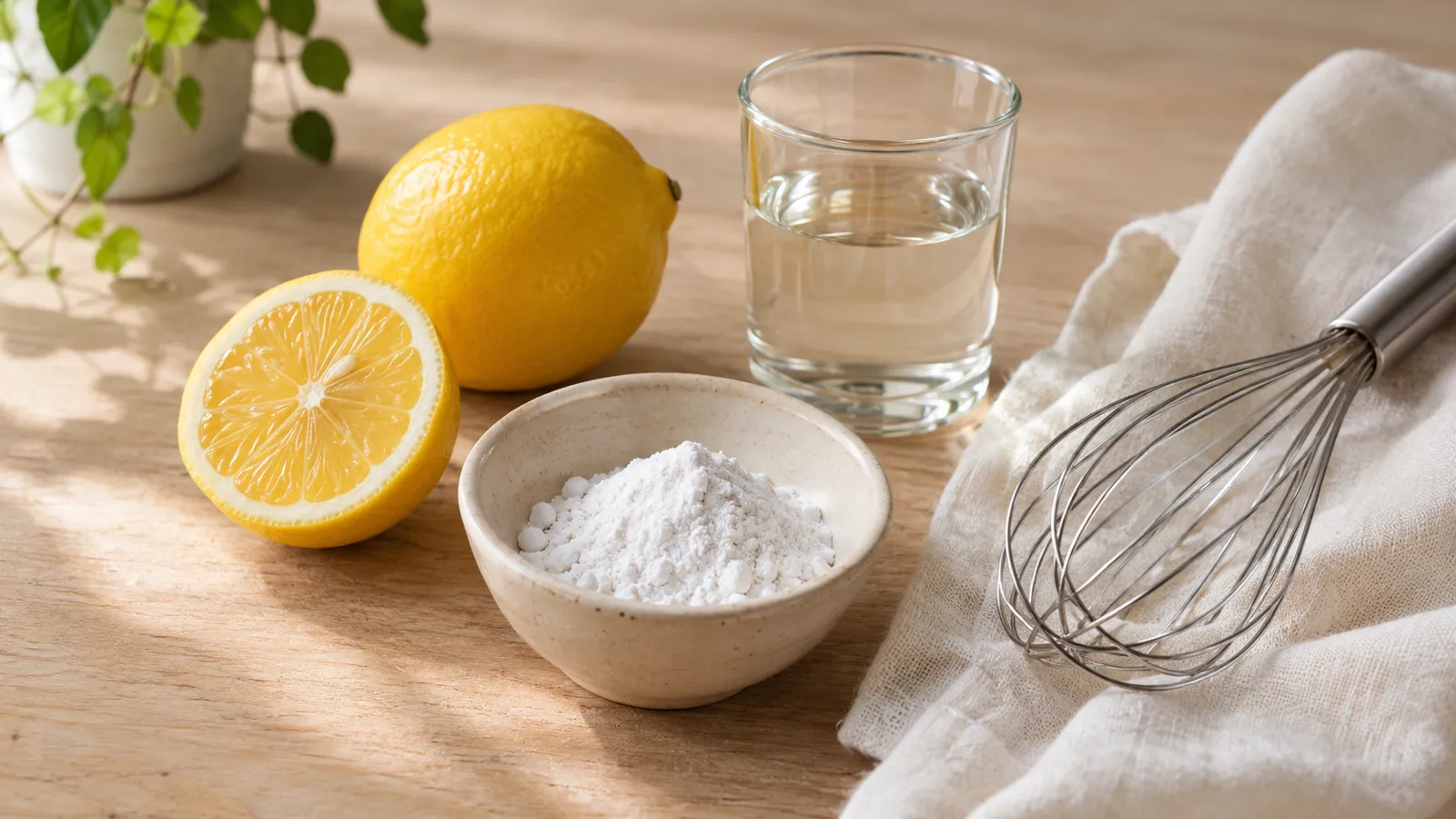
Identify its job before choosing an acid
Whipped egg whites and a batter containing baking soda present different problems. My recommendation is to use an acid alternative only for the task its source describes. For candy, choose a complete alternative method. A single ratio applied to every use of cream of tartar creates more uncertainty than it resolves.
The missing ingredient may be helping stabilize egg foam, supplying acid for a leavener, or influencing a sugar mixture. These are different jobs. The useful first question is therefore “What is it doing here?” rather than “What is the universal replacement ratio?”
Read the ingredient list and the step where cream of tartar is added. If it goes into egg whites as they are whipped, you are dealing with a different situation from a cookie recipe that combines it with baking soda in the dry ingredients.
For egg whites: a small amount of lemon juice or vinegar
King Arthur's baking guidance suggests starting with one-eighth to one-quarter teaspoon of lemon juice or vinegar per egg white when the original method calls for a pinch to one-eighth teaspoon of cream of tartar per white. Keep that context attached to the quantity. It is not a universal two-for-one conversion for every recipe.
For two whites under those stated conditions, the arithmetic gives one-quarter to one-half teaspoon of lemon juice or vinegar. Choose a specific method and follow it rather than repeatedly adding acid until the foam “looks right.” Small additions are easier to measure accurately than a vague squeeze from half a lemon.
Use a clean bowl and suitable equipment, and follow the original method's sequence for whipping and adding sugar. A replacement acid does not compensate for every technique problem. If the mixture is not developing as expected, adding more substitute is not automatically the answer.
Can you leave it out of a meringue?
Some methods are designed without cream of tartar, but omitting it from a method that expects it changes that method. The most dependable approach is to use a complete meringue formula that matches the ingredients available.
Consider what the foam needs to survive. A topping baked promptly, a piped shape expected to hold, and a foam folded into batter do not ask exactly the same thing from the mixture. A result that is acceptable for one use may not be suitable for another.
For food safety, also follow the recipe's cooking instructions and official egg guidance. An acid added for foam behavior is not a substitute for cooking or pasteurization. Do not treat a bowl of glossy whipped whites as proof that raw egg risks have been removed.
When cream of tartar is paired with baking soda
Here the acid is part of a leavening system. Replacing it with baking powder while leaving the original soda unchanged can alter the balance. A good substitution needs to account for both original ingredients and for how the rest of the formula behaves.
Look for a note from the recipe author that replaces the pair together. If none is available, choose a version developed with baking powder instead of improvising a correction to an already mixed dough. Baking-powder products also vary, so an apparently neat ratio may not reproduce every formula.
This is particularly relevant to cookies whose texture and tang are part of their identity. A cookie can rise and still taste different. Decide whether you need an approximation for a casual batch or the specific character of the original.
Why candy and syrups need extra care
A candy formula is more than its list of acids. Sugar concentration, temperature, timing, and the intended final texture work together. A substitute that is convenient in whipped egg whites should not be carried into sugar work without a recipe-specific reason.
Follow a reliable formula's stated alternative and keep the rest of the process consistent. If you change the acid, cooking temperature, and liquid amount together, you lose the ability to tell which change affected the result.
Hot sugar also requires careful handling regardless of the ingredient choice. Set up the equipment and read the complete method before starting; do not pause mid-cook to search for a missing ingredient.
Check the bottle as well as the amount
Use a food ingredient with the flavor and identity the method expects. A strongly flavored vinegar can carry an unwanted taste into a delicate preparation. Cleaning vinegar and other household products are not interchangeable with a food-grade ingredient specified for cooking.
Lemon juice contributes flavor and liquid as well as acidity. That may be welcome in a lemon dessert and less welcome elsewhere. If flavor is critical, choose a recipe designed around the substitute instead of assuming the small quantity will always be undetectable.
Two ingredient lists that should lead to different choices
In the first recipe, cream of tartar appears beside egg whites and sugar, with instructions to whip the whites. Read a replacement specifically intended for that foam and its egg-white quantity. In the second, it appears with baking soda among dry ingredients. Here you are looking at a leavening system; an egg-white substitution does not answer the question.
If you also have baking powder, check the baking-powder guide to understand the relationship, but do not add a full replacement while leaving all the original soda in place. I would write out which ingredients are being removed and added before mixing. That small check prevents the common mistake of solving for cream of tartar twice.
FAQ
How much lemon juice should I use for egg whites?
For methods calling for a pinch to ⅛ teaspoon cream of tartar per white, King Arthur suggests starting with ⅛–¼ teaspoon lemon juice or vinegar per white. Keep that context attached to the amount. It is not a universal conversion for dough, candy, or every meringue formula.
Can baking powder stabilize whipped egg whites instead?
Do not use it as an equivalent foam-stabilizing replacement. Baking powder is a leavening mixture with a different purpose. Follow a method that uses a suitable small acid addition or a complete egg-white preparation designed without cream of tartar, rather than swapping powders by appearance.
Can I simply omit cream of tartar from cookies?
Omission changes the formula, particularly when the ingredient is paired with baking soda. The result may differ in taste and structure. A recipe developed without cream of tartar is more dependable than removing the acid from an existing leavening system and hoping the original behavior remains.
Does adding lemon juice make raw egg whites safe?
Do not treat an acid used for foam behavior as a food-safety treatment. Follow the recipe’s cooking instructions and official guidance for eggs, including pasteurized products where appropriate. A glossy or stable foam does not demonstrate that raw egg risks have been removed.
Can I use the same ratio in candy?
Not automatically. Sugar work depends on the full formula and process, so an egg-white substitution does not establish a candy substitution. Use a reliable formula’s stated alternative, keep its temperatures and quantities together, and avoid improvising while a hot sugar mixture is already cooking.