Sour Cream Substitute: Yogurt and Other Options
Use plain yogurt in the same volume as sour cream as a practical starting substitution. Match thickness to the dish: Greek yogurt suits toppings better than a thin yogurt. Heat and fat content can change the result.
| Use | Starting choice | What to watch |
|---|---|---|
| Cold topping | Plain thick yogurt, same volume | Tang and richness differ |
| Dip | Plain Greek yogurt, same volume | Check final thickness |
| Baking | Plain yogurt, recipe-specific if possible | Fat content and moisture |
| Hot sauce | Follow a yogurt-based sauce method | High heat can split dairy |
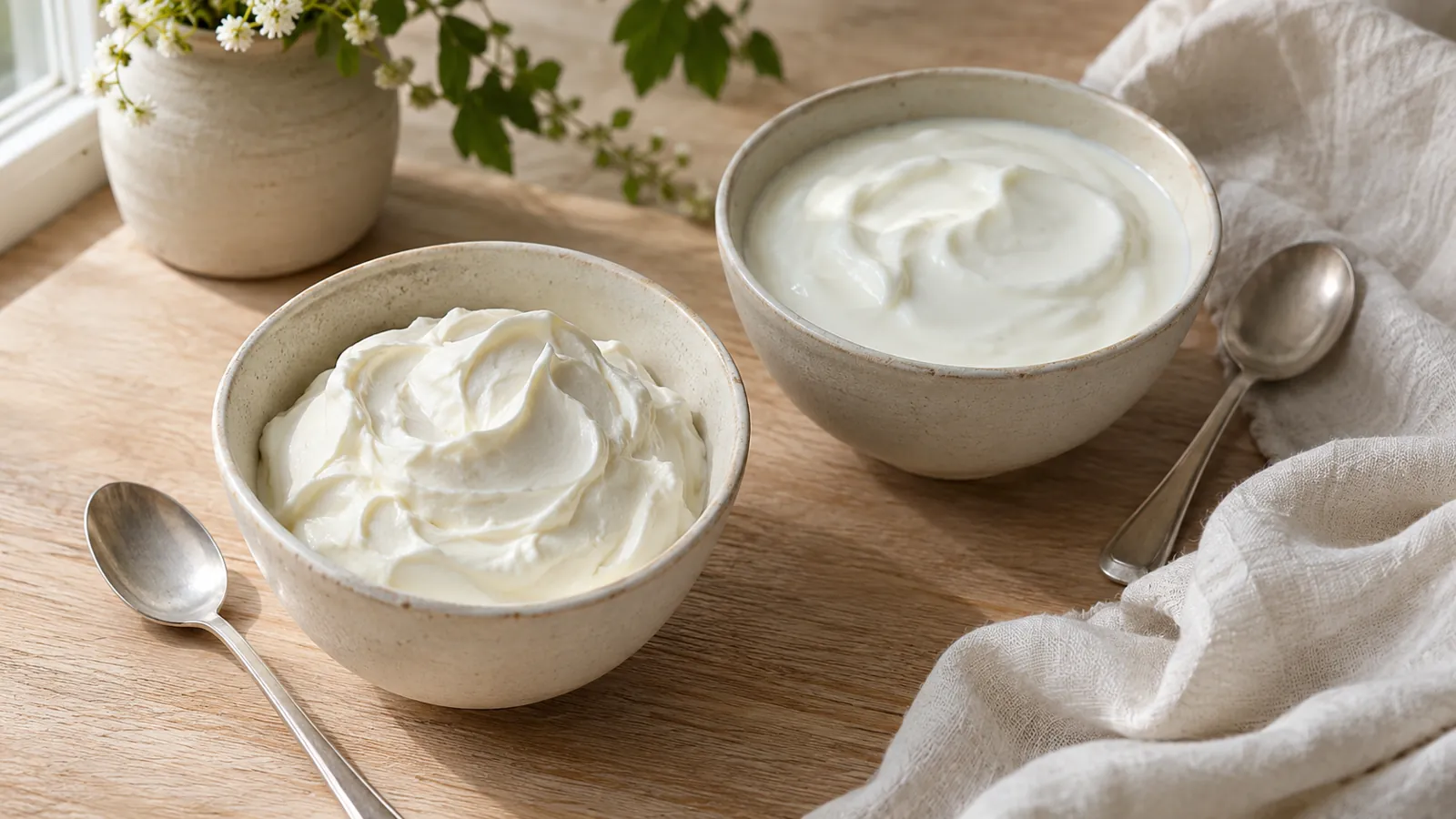
Choose thickness for toppings, composition for baking
For a baked-potato topping or spoonable dip, plain Greek yogurt is my first choice because its thickness suits the job. In a cake, give priority to the recipe’s specified alternative and fat level. A good topping substitute does not automatically reproduce the same batter. If the recipe calls for buttermilk instead, the buttermilk substitute guide covers that swap.
Plain means unsweetened and unflavored
Vanilla yogurt brings both flavor and often sugar. Fruit yogurt introduces still more variables. Neither should be treated as plain yogurt just because the container looks similar. Read the ingredients as well as the name on the lid.
Full-fat, reduced-fat, and nonfat products also differ. A nonfat replacement may supply tang without reproducing the richness of sour cream. That can be acceptable in a topping, but it is a meaningful change in a rich cake or a dairy-heavy dip.
Thickness matters before seasoning
Greek yogurt is generally thicker than regular yogurt, but brands vary. Stir the product and assess its consistency before making a dip. Adding a watery ingredient first and trying to fix it with more seasoning leaves the underlying texture problem unsolved.
For a topping, spoon a small amount onto the plate first. If it runs farther than you want, choose a thicker plain yogurt. For a baked item, avoid improvised draining or liquid additions unless the recipe explains them: those changes alter the amount of water you are adding.
Hot sauces need their own method
Do not assume yogurt can be boiled aggressively because sour cream appears in the original ingredient list. Heat behavior depends on the product and the sauce. Use a method designed for yogurt where possible, especially for an acidic sauce.
If a recipe directs you to temper dairy with warm liquid or add it off the heat, keep that step. A lumpy sauce is a texture problem, but appearance alone cannot establish whether the dairy was handled safely before cooking.
Other creamy ingredients are not equivalent
Cream cheese is substantially thicker, heavy cream is pourable, and mayonnaise has a different flavor and composition. Each can be useful in an appropriate recipe, but none supplies a universal same-volume sour cream replacement.
For a dairy-free dish, a product labeled as a sour cream alternative may be the simplest starting point. Check its ingredients and directions. Coconut flavor, added starches, and different fat levels can all affect a finished dish; a white color is not enough to establish a match.
A half-cup topping is not the same problem as a half-cup in cake
If you need half a cup of sour cream for a cold topping, measure half a cup of plain yogurt and assess it before seasoning. Taste for tang and look at whether it holds on a spoon. That tells you directly whether it suits the job. I would not thin thick yogurt automatically: the thickness may be precisely what you need.
If the same half-cup goes into cake batter, tasting the yogurt cannot predict the cooled crumb. Check the recipe's dairy options before mixing. A nonfat yogurt is not equivalent to a full-fat one simply because both measure half a cup. Keep flavor, thickness, and fat content as separate checks; fixing one does not necessarily fix the others.
FAQ
Is Greek yogurt a one-to-one sour cream substitute?
It can be a practical same-volume choice for toppings and dips. Its thickness is helpful, but flavor and fat content differ by product. In baking, prefer a recipe that explicitly allows Greek yogurt rather than assuming every cake will behave identically.
Can I use sweetened yogurt?
Not as a neutral substitution. Sweetened yogurt changes the sugar balance, and flavored yogurt changes the taste as well. Choose plain yogurt unless you are deliberately adapting a recipe and can account for those additions.
Will nonfat yogurt work?
It may work where tang and moisture matter more than richness. It does not reproduce the fat contribution of full-fat sour cream. Check the recipe and assess the desired texture before choosing it for a rich cake or sauce.
Can I replace sour cream with milk?
Milk is much thinner and does not provide the same acidity or richness. A direct same-volume substitution can make a dip runny or change a batter. Use a complete recipe-specific adjustment instead of simply pouring in milk.
Is yogurt automatically suitable for a dairy allergy?
No. Ordinary yogurt and sour cream are both dairy foods. For an allergy requirement, check the full label and cross-contact information on an appropriate alternative. Do not infer suitability from a product being lower in fat or lactose.