Can You Freeze Cream Cheese? Expect Graininess
You can freeze cream cheese, but it does not freeze well for a smooth spread. NCHFP warns of poor freezing performance; choose fresh cream cheese for a silky frosting, cheesecake, or bagel topping where texture matters.
| Intended use | Editorial choice | Reason |
|---|---|---|
| Smooth spread or frosting | Use fresh | Graininess is conspicuous |
| Cream cheese mixed with heavy cream | NCHFP identifies freezing for dips or sandwich-loaf icing | Specific mixture, not every frosting |
| Delicate cheesecake | Follow its tested formula | Do not assume freezing has no effect |
Decide whether the texture can change
Picture the spoonful first. If it's going on a plain bagel, keep the cream cheese fresh, because a bagel has nowhere to hide a grainy texture. A flexible cooked filling may be more forgiving, though I'd hesitate to count on every thawed block disappearing perfectly into it.
The National Center for Home Food Preservation explicitly lists cream cheese among cheeses that do not freeze well. I read that as a quality warning, with no suggestion that freezing itself makes the food poisonous. Safe handling and acceptable texture are separate questions.
One documented way to freeze it
NCHFP makes a useful exception: cream cheese combined with heavy cream can be frozen for later use in dips or as icing on frozen sandwich loaves. If you want a make-ahead, that's the direction I'd go, ahead of freezing a plain block and hoping for a flawless bagel spread. The source supplies no mixing ratio and makes no promise about every sweet frosting, so pick that use deliberately. A splash of cream is no repair for just any thawed product.
For an unopened block you'll need soon, I'd still choose the refrigerator. For a surplus intended for a cooked filling, divide it by the amount that filling needs before freezing. Once it's thawed, stir gently and look at whether the texture will be noticeable in that dish. A little graininess matters less in a chunky cooked filling than in a smooth icing piped across a cake.
Do not promise that blending restores it
Thawed cream cheese may release liquid or feel less uniform. Stirring can redistribute some moisture, and that's as far as I'd trust it, because the original texture is never guaranteed. For a celebration frosting, I'd insist on fresh cream cheese over a rescue technique nobody has checked against that actual product.
Block cream cheese, whipped spreads, reduced-fat versions, and flavored tubs are different products, and their formulations affect how they behave. Follow any freezing advice the manufacturer supplies. The words "cream cheese" on the lid prove nothing about how all versions respond.
Package only what has been handled safely
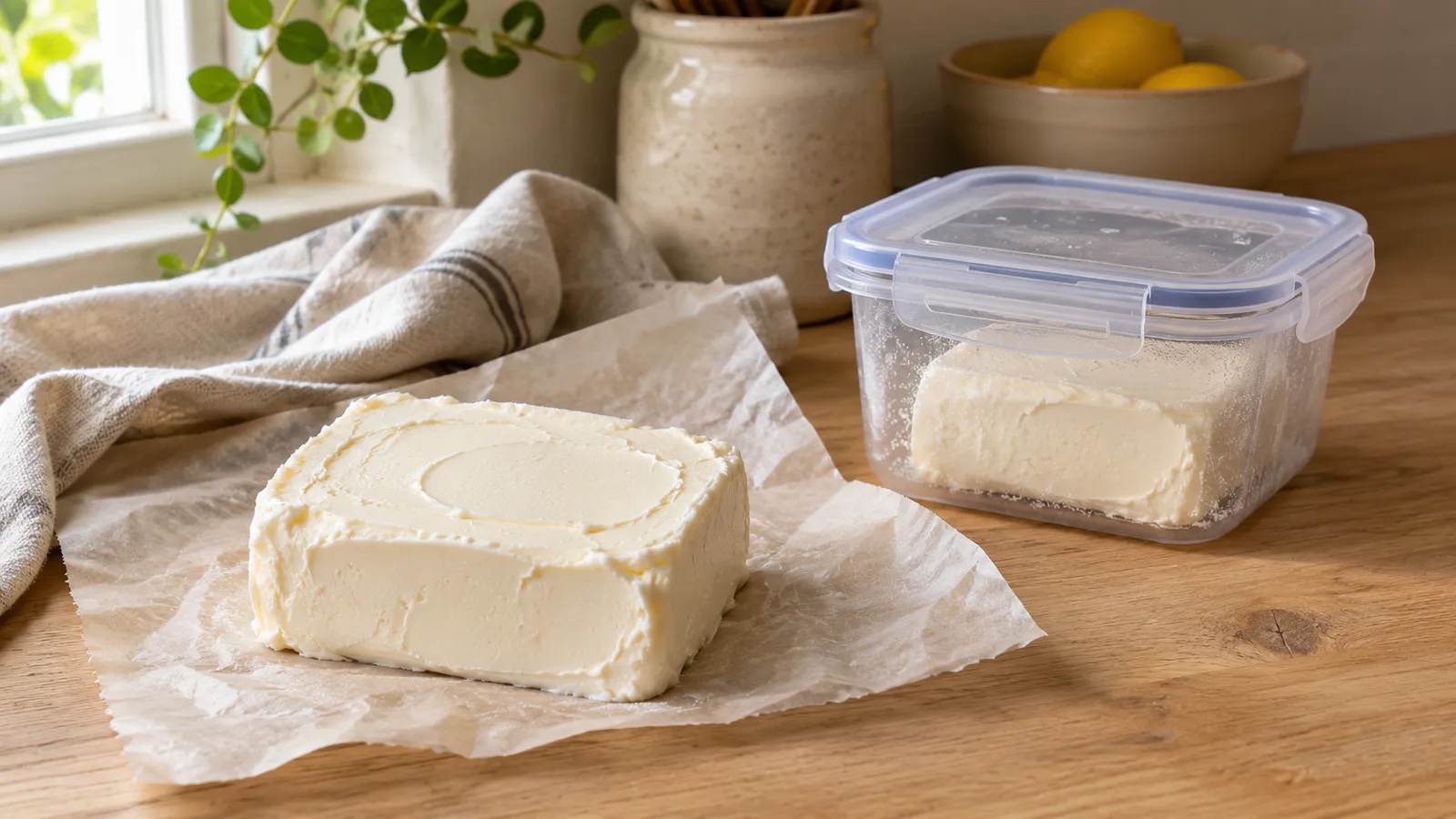
If you do freeze it, portion it for a specific later use and protect it with freezer-suitable wrapping or a sealed container. Label the product and freezing date, and retain the original package information. An opened tub should have a known history before you put it away.
Keep cream cheese at 40°F (4°C) or below and refrigerate within two hours, or one hour above 90°F (32°C). Do not freeze cream cheese that exceeded those limits, has mold, or otherwise seems spoiled. Freezing does not undo prior handling. If there is mold on this soft cheese, do not trim a visible patch and treat the rest as sound; discard the product.
Thaw cold and choose the next use honestly
NCHFP recommends refrigerator thawing for cheese and other dairy products. Keep the package in a container that catches any moisture and use the thawed product promptly under its label guidance. I'd distrust any universal number of refrigerator days here, since it would ignore the product and how long it was open before freezing.
Inspect the thawed texture before committing it to a larger dish. The general cheese freezing guide explains why hard cheeses are a different case, and the sour cream substitution guide can help if your dish is flexible. Sometimes the smarter call is a different suitable ingredient, and I'd take that over forcing thawed cream cheese into a smooth finish.
FAQ
Can I use frozen cream cheese for cheesecake?
I would choose fresh cream cheese when the finished texture is central to the dessert. A thawed block may behave differently, and a large cheesecake commits other ingredients before you see the result. If you want to use it, choose a formula that explicitly supports that product and condition.
Is watery cream cheese automatically spoiled?
Liquid separation after freezing can be a texture change, but it is not proof of safety either. Consider the storage history and the manufacturer’s guidance. Discard moldy or otherwise spoiled product, and do not use a taste test to settle whether questionable handling was acceptable.
Can I freeze a tub in its original package?
Only if the packaging is suitable for freezing and the manufacturer’s guidance allows it. A tightly covered retail tub may still benefit from additional protection against freezer air. Keep the original label details and date your freezing decision so you do not later confuse it with an unopened fresh tub.
Can I thaw cream cheese on the counter?
Use the refrigerator for thawing rather than leaving a perishable dairy product out while the center stays frozen. Plan ahead for the amount you need. A faster softening trick intended for fresh cream cheese should not automatically be treated as an appropriate method for thawing a frozen block.
Does whipping make thawed cream cheese identical to fresh?
No guaranteed method restores every thawed product to its original state. Whipping may change the appearance without eliminating graininess or excess moisture. Evaluate a small amount before adding sugar or other ingredients, especially when the final use needs a smooth, stable finish.