Can You Freeze Milk?
Yes, milk can be frozen, but it may separate and feel grainier after thawing. Freeze it while fresh, leave expansion space in a freezer-safe container, and thaw in the refrigerator.
| Your plan | Packaging choice | After thawing |
|---|---|---|
| Cooking or baking | Measured portions | Stir or shake; assess texture |
| Small daily quantities | Small freezer-safe containers | Thaw only what you need |
| Drinking plain | Try a small portion first | Texture may be less appealing |
Choose portions before freezing
A little surplus milk should never turn into an oversized thawing job. For baking or a cooked sauce, measured portions stay useful even if the milk's texture changes. For drinking, I'd try one small frozen portion before committing the whole container.
Choose the future use before filling a container
Freezing is at its best when it solves a specific waste problem. Need a cup of milk for a batter next week? Freeze a measured cup now. If that batter calls for buttermilk, the buttermilk substitute guide starts from ordinary milk, and freezing cheese has its own guide. Freeze an entire large jug, on the other hand, and you may later have to thaw much more than the recipe requires.
If you mainly want milk for drinking, make the first experiment small. A change that's barely noticeable in a cooked dish can be more obvious in a glass, and I think a glass of plain milk is the hardest test you could set it. That's a quality preference, separate from whether the milk was handled safely.
Leave space for expansion
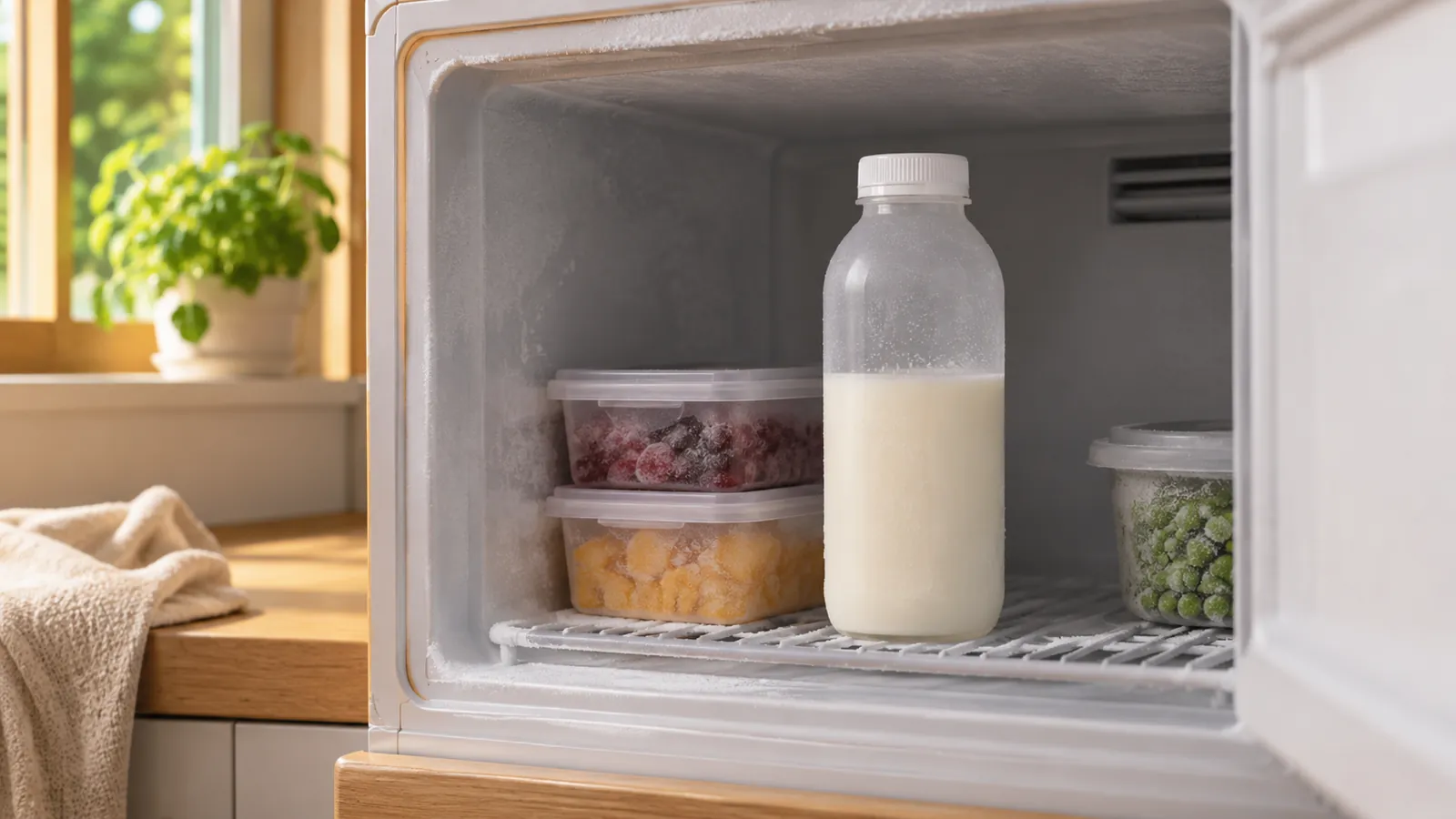
Do not fill a rigid container to the brim. Liquid expands as it freezes, so use packaging intended for freezer use and follow its headspace instructions. An ordinary glass bottle gets no automatic pass. I'd count a broken container as a packaging failure, and never as some unavoidable part of freezing dairy.
Label the portion with the freezing date and amount, and if the milk was already open, record that too. Freezing doesn't erase the handling history the milk arrived with, and an undated white block gives you little information when you're planning a recipe.
Separation is a texture change, not a safety verdict
University extension guidance describes texture changes and separation after freezing milk. Stirring or shaking can redistribute the contents, but may not recreate the exact texture of the original product, and I'd go in expecting different milks to thaw differently.
Equally, do not use separation alone to decide that mishandled milk is acceptable. To me that's the more serious of the two mistakes. If the product had an unsafe temperature history before or after freezing, mixing it smooth does not fix that problem. The appearance of a thawed drink cannot stand in for storage records.
Thaw a manageable amount in the refrigerator
Move a portion to the refrigerator in a container that can catch condensation or a leak, and plan ahead so the counter never looks like a good way to speed things up. Larger portions take longer to thaw; shape and container size matter as well as quantity.
Once thawed, use the milk promptly and follow any product-specific guidance. I can't honestly promise that every opened milk, regardless of its age before freezing, gains a full new week afterward. Keep the portion small enough that finishing it is realistic.
Different products deserve different decisions
Dairy milk, plant-based drinks, cultured dairy, and infant feeding products each have their own handling instructions, so check the product label. This guide concerns ordinary food milk only. Breast milk and prepared infant formula are outside it and need their own guidance.
If a plant-based drink's manufacturer advises against freezing, I'd take them at their word; a dairy-milk example has no power to override that advice. Ingredients used to keep a beverage smooth can behave differently when frozen. Try a small portion only where the product guidance allows it.
Two cups left, but your recipe uses half a cup
With two cups of suitable milk and a recipe that usually needs half a cup at a time, I'd go with four half-cup portions over one two-cup block. Leave the expansion space the freezer-safe container requires, and resist filling four small jars to the brim. Label both the amount and the date.
Thaw a portion in the refrigerator and stir or shake as appropriate to redistribute separation. I'd use it in a suitable recipe while keeping its previous opening and storage history in mind. If the product label advises against freezing, follow that direction. This example is for ordinary food milk; breast milk and infant formula require separate guidance.
FAQ
Can I freeze milk in its original carton?
Only if the packaging is suitable and there is room for expansion. A full rigid container can split or leak. A freezer-safe container with the recommended headspace gives more control, especially when you also want to divide the milk into measured recipe portions.
Will thawed milk taste exactly the same?
Not necessarily. Separation and texture changes can make it less appealing for drinking even when it was handled properly. Test a small portion for your preferred use before freezing a large amount, and distinguish a quality disappointment from an unsafe storage history.
Can I thaw it on the countertop?
Use the refrigerator so the milk remains cold while thawing. A warm exterior can develop before the frozen center softens, making counter thawing an unsuitable shortcut. Smaller portions are easier to plan around and reduce the temptation to accelerate a large frozen jug.
Does freezing rescue milk that has spoiled?
No. Start with milk that is still safe and fresh enough to use. Freezing is a storage decision, not a treatment that reverses spoilage or unsafe handling. Do not taste questionable milk to determine whether it is worth saving for a future recipe.
Can I apply this to infant formula?
No. Infant formula and breast milk have their own handling instructions and should not be managed through a general kitchen-milk guide. Follow the relevant official guidance and product directions. The fact that both are liquids does not make their storage requirements interchangeable.