Can You Freeze Pumpkin Pie? Storage and Thawing
Yes: baked pumpkin pie keeps for 1–2 months in the freezer for best quality, or 3–4 days refrigerated at 40°F (4°C) or below. Expect possible softening of the crust or separation in the filling after thawing.
| Pie condition | Storage guidance | What to expect |
|---|---|---|
| Baked, refrigerated | 3–4 days at 40°F or below | Cover against drying |
| Baked, frozen | 1–2 months at 0°F or below | Quality window, not an expiry switch |
| Commercial shelf-stable pie | Follow its label | Do not transfer that rule to homemade pie |
Choose convenience with a texture tradeoff
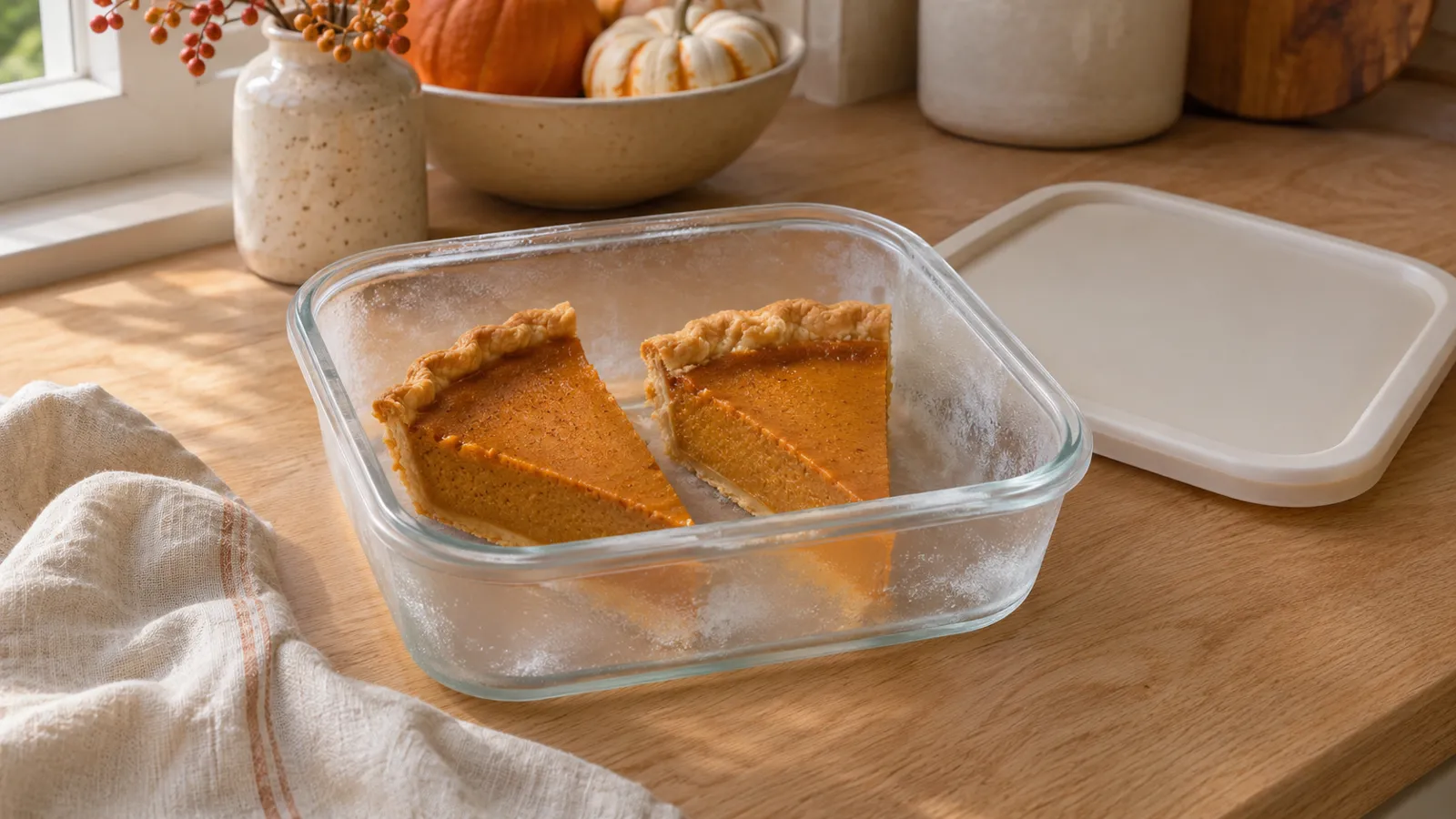
The leftover slice is the easy call: freeze it. A pie with guests waiting is harder, and for a celebration where the crust needs to be at its best, I'd go with a freshly prepared pie or a short refrigerated hold. A frozen slice can still be very useful. It just won't be indistinguishable from the day it was baked.
The FoodSafety.gov chart specifically includes baked pumpkin pie, so keep that category apart from every other custard or cream pie. Similar-looking desserts can have different freezer guidance, and a topping may behave differently from the pie beneath it.
Chill safely before wrapping for the freezer
Pumpkin filling commonly includes eggs and dairy, so treat homemade pie as perishable. Refrigerate within two hours. It has no business sitting out all afternoon to reach room temperature, however nice it looks on the sideboard. For general handling details, use the leftover guide.
Once chilled, protect the pie from air with suitable wrapping and a freezer container or bag. Support a whole pie on a stable base. For slices, separate the portions so you can remove what you need without thawing the rest. Label the baking and freezing dates, because a note that only says "Thanksgiving" will help nobody in January.
Keep the topping separate
Whipped cream goes on after thawing, in my view. That keeps the storage decision focused on the pie and gives you a fresh finish even if the crust has softened slightly. A heavily decorated pie is also harder to wrap without damaging its surface.
If the filling releases moisture, I wouldn't count on extra decoration to hide every change. Thaw one portion and judge whether the texture suits the planned serving style. That's especially worth doing with an unfamiliar dairy-free formula, where the usual dairy custard assumptions may not apply.
Thaw in the refrigerator
Let the pie thaw under refrigeration, protected from other foods and odors. A whole pie takes longer than a slice, so plan ahead and keep it off a warm counter, however short on time you are. You'll get no single thawing hour from me, because one number can't work for every pan size.
Keep track of the time the pie spent refrigerated before freezing and use it promptly after thawing; freezing should not be used to restart the full refrigerator window. If a recipe calls for evaporated milk, the evaporated milk substitution guide also explains why changing the dairy can change the structure. Storage cannot reverse a filling that never set properly.
Whole pie or individual slices?
A whole pie makes sense when it's going to one gathering. Keep it in a freezer-safe pie plate, protect the exposed filling, and use a rigid outer container so other packages leave the crust alone. For lunches or a small household, I'd take slices: wrap them separately and place them in one labeled container. You can then thaw dessert without committing to the whole pie.
Put the pie in the refrigerator ahead of the meal and check that the center is no longer icy before serving. A deep pie and a thin slice need different lead times. If the center is still frozen, keep thawing it cold; moving it to the counter creates a warm outer portion while the middle remains icy. Leave it protected during thawing to limit contact with refrigerator odors and drips.
After thawing, blot loose surface moisture gently if needed and add the topping near serving time. Expect the crust to be softer than a fresh crust. I'd accept that, serve the slice as it is, and spare a set custard the repeated heating in pursuit of crisp pastry.
FAQ
Can I freeze store-bought pumpkin pie?
Follow the package’s storage instructions, especially if it has a special topping or was previously frozen. A commercially shelf-stable pie is formulated and handled differently from a homemade custard pie. Do not copy its counter-storage permission onto a pie you made with eggs and dairy.
Can I freeze an unbaked pumpkin pie?
There are extension methods for freezing an unbaked pie, but they come with specific baking directions. This guide’s one-to-two-month reference is for baked pumpkin pie. Use a complete unbaked-pie method rather than transferring the baked-pie storage number and guessing how to cook the frozen filling.
Why did the crust turn soft?
Moisture from the filling and thawing can soften a crust that was crisp before freezing. That is a quality change and one reason to set realistic expectations. A smaller portion and protective wrapping help handling, but neither can guarantee that every crust will recover its original texture.
Can I leave pumpkin pie out overnight?
Not a homemade perishable pumpkin pie. It needs prompt refrigeration, and an overnight counter stay should not be rescued by freezing or reheating. Commercial products may have different label instructions, but those instructions apply to that product and its packaging rather than to all pumpkin pies.
Is a pie unsafe the day its freezer window ends?
The freezer interval describes best quality when storage stays consistently cold; it is not a date when a safely frozen pie instantly becomes unsafe. Its handling before freezing still matters. An unsafe counter stay cannot be canceled by a long spell in the freezer.